
Jiaozuo Attractions: Top 6 Must-Visit Places & Travel Guide 2026
Jiaozuo Attractions Guide
Jiaozuo, a city in northwestern Henan Province, sits at the southern foot of the Taihang Mountains and on the banks of the Yellow River. It is home to world‑class geological wonders, the birthplace of Tai Chi, and rich Yellow River culture. Here you will find Yuntai Mountain – one of the first UNESCO Global Geoparks – as well as Qingtian River, known as the “Northern Three Gorges,” and Chenjiagou, a pilgrimage site for Tai Chi enthusiasts. For foreign travelers, Jiaozuo offers a perfect blend of natural landscapes, martial arts culture, and historical sites. This guide recommends the best attractions in Jiaozuo and provides detailed practical information.
Jiaozuo Attractions Overview
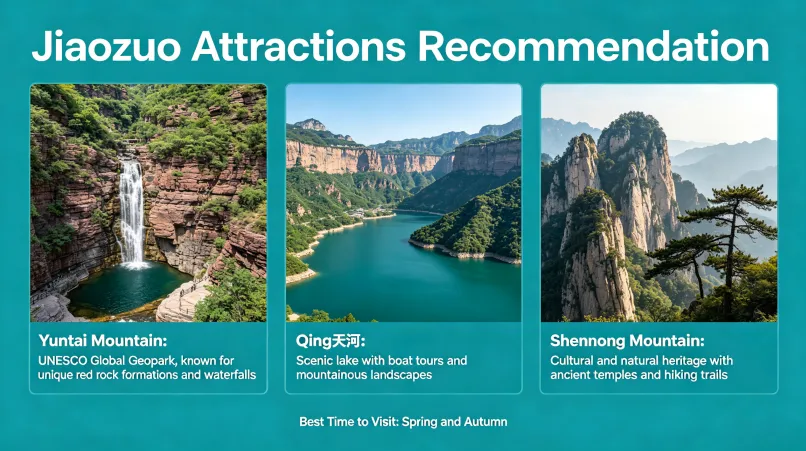
Jiaozuo’s tourism resources are highly concentrated. The core can be summarized as “one mountain (Yuntai Mountain), one river (Qingtian River), one fist (Chenjiagou Tai Chi), and one temple (Jiaying Temple).” Yuntai Mountain is the absolute highlight, but the other attractions each have their own unique character. Depending on your travel time and interests, you can choose 2–4 of them to combine. Transportation between Jiaozuo’s attractions is fairly convenient – suitable for self‑driving or private car, and there are also tourist bus routes.
Must‑Visit Attractions in Jiaozuo
Yuntai Mountain Scenic Area – A Model UNESCO Global Geopark
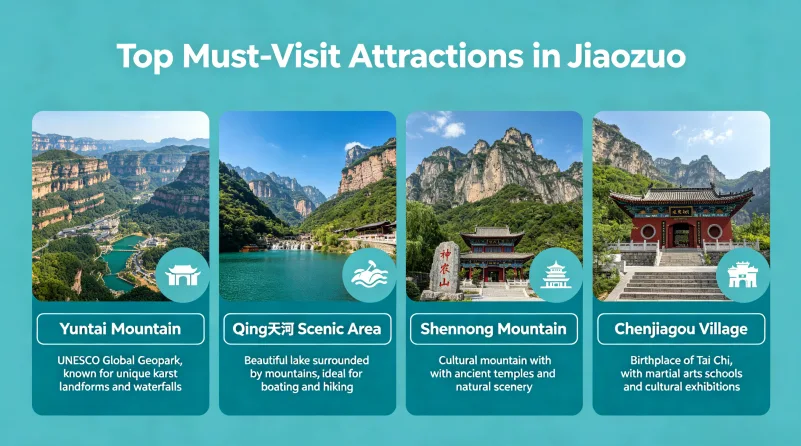
Yuntai Mountain is the most famous natural scenic area in Jiaozuo and even in Henan Province. It is one of the first UNESCO Global Geoparks and a national 5A tourist attraction. It is famous for its rust‑red Red Stone Gorge, the 314‑meter (1,030‑foot) Yuntai Waterfall (the highest single‑drop waterfall in Asia), the cloud‑covered Zhuyu Peak, and the crystal‑clear Tanpu Gorge.
Core highlights:
- Red Stone Gorge: About 2 km (1.2 miles) long, named for its rust‑red rocks. It is known as the “No. 1 Canyon in China.” The deepest part reaches 68 meters (223 feet) underground, with winding plank roads, waterfalls, deep pools, and cliffs. Best visited in the morning, when sunlight makes the red rock walls glow.
- Quanpu Gorge: At its end is the Yuntai Waterfall, the highest single‑drop waterfall in Asia, with a drop of 314 meters. During the rainy season, the waterfall is thunderous and misty.
- Tanpu Gorge: Known for “a spring every three steps, a waterfall every five steps, and a pool every ten steps.” The water is clean, and the scenery is beautiful.
- Zhuyu Peak: The main peak is 1,308 meters (4,291 feet) high. You can take a cable car or climb up. The Tang dynasty poet Wang Wei wrote a famous poem here that includes the line: “I know my brothers would climb the peak today, each with a zhuyu plant in his hair, thinking of me far away.” The summit offers a panoramic view of the Taihang mountain range.
- Macaque Valley: Home to many wild Taihang macaques – you can observe them from a distance, but do not feed them.
- Zifang Lake: Legend has it that Zhang Liang, a famous Han dynasty strategist, lived in seclusion here. You can take a boat ride on the lake.
Practical information:
- Ticket: 120 RMB; scenic shuttle bus 60 RMB (valid for 3 days)
- Opening hours: Peak season 6:30–18:00, off‑season 7:00–17:30
- Recommended visit duration: 2 days (strongly recommended to stay overnight inside the scenic area)
Why you must go: Yuntai Mountain combines canyons, waterfalls, peaks, and lakes into one stunning landscape. It is the essence of the Taihang Mountains and a rare example of karst topography and red‑rock canyon scenery in northern China.
Qingtian River Scenic Area – The “Northern Three Gorges” The
The Qingtian River is located in Bo’ai County, Jiaozuo. Because it combines the rugged grandeur of northern mountains with the gentle beauty of southern rivers, it is known as the “Northern Three Gorges.” It features both the majesty of a high gorge and a calm lake, as well as the reflection of peaks in clear water.
Core highlights:
- Daquan Lake: The core area. You can take a boat ride through the gorge, with green mountains on both sides and clear, jade‑green water – reminiscent of the Yangtze River’s Three Gorges.
- Guanyin Gorge: Known for its deep canyon and waterfall clusters. The walking trail takes about 1.5 hours.
- Fo’er Gorge: The gorge is shaped like a Buddha’s ear, with several waterfalls and deep pools.
- Jinjialing: The best spot to see autumn red leaves. From late October to early November, nearly 10,000 acres of Taihang red leaves cover the mountains – a paradise for photographers.
Practical information:
- Ticket: 60 RMB; boat ticket about 45 RMB (one way)
- Opening hours: 8:00–17:30
- Recommended visit duration: Half a day to one full day
Why you must go: Qingtian River is an important part of the Yuntai Mountain UNESCO Global Geopark. It is known for its water scenery and gentle beauty, and the autumn red leaves are exceptional.
Shennong Mountain Scenic Area – Dragon Ridge Great Wall & Taihang Macaques
Shennong Mountain is located in Qinyang City, Jiaozuo. It is named after the legend that the Yan Emperor (Shennong) distinguished grains and tasted herbs here. It is also a national nature reserve for macaques.
Core highlights:
- Dragon Ridge Great Wall: A natural stone ridge winding along the mountain crest for 11.5 km (7.1 miles), like a giant dragon. Walking along it is thrilling, with cliffs on both sides.
- Zijin Peak: The main peak is 1,028 meters (3,373 feet) high. You can take a cable car or climb up. At the summit stands an ancient altar where Shennong supposedly worshipped heaven.
- Taihang macaques: More than 3,000 wild macaques live on the mountain. They are lively and cute, but keep a safe distance and do not provoke them.
- Dragon‑scale pines (white‑barked pines): Ancient pines growing on cliffs, with white bark and strange shapes.
Practical information:
- Ticket: 60 RMB; cable car one way 40 RMB, round trip 70 RMB
- Opening hours: 8:00–17:30
- Recommended visit duration: Half a day to one full day
Why you must go: The Dragon Ridge Great Wall is unique in China. Shennong Mountain perfectly combines geological wonders with macaque ecology.
Chenjiagou – Birthplace of Tai Chi
Chenjiagou is located in Wen County, Jiaozuo. It is the birthplace of Tai Chi. During the Hongwu period of the Ming dynasty, the Chen family moved here and developed their family martial art into Chen‑style Tai Chi. After centuries of transmission, it is now a UNESCO Intangible Cultural Heritage.
Core highlights:
- Tai Chi Ancestral Temple: A shrine dedicated to the successive grandmasters of Chen‑style Tai Chi. The architecture is simple and traditional, with detailed exhibitions on the origin and development of Tai Chi.
- Yang Luchan’s Training Site: The place where Yang Luchan, an outsider, secretly learned Tai Chi and later became a grandmaster – a famous story in Tai Chi history.
- Tai Chi performances: Several shows every day, performed by lineage holders or professional students, demonstrating the combination of softness and hardness in Chen‑style Tai Chi.
- Tai Chi experience class: You can book a 1–2-hour class with a lineage holder to learn basic movements and experience Tai Chi culture.
Practical information:
- Ticket: 40 RMB (experience class not included)
- Opening hours: 8:00–17:30
- Recommended visit duration: 2–3 hours (excluding experience class)
Why you must go: For martial arts lovers and cultural travelers, Chenjiagou is a “holy land” of Tai Chi, offering a deep understanding of this traditional Chinese art.
Jiaying Temple – “Yellow River Forbidden City”
Jiaying Temple is located in Wuzhi County, Jiaozuo. It was first built in 1723 AD (the first year of the Yongzheng era of the Qing dynasty). Emperor Yongzheng ordered it built as a “Dragon King Temple for the Yellow and Huai Rivers” to control flooding. Because its architecture imitates the Forbidden City in Beijing, it is also called the “Yellow River Forbidden City.”
Core highlights:
- Yongzheng Imperial Stele: A copper stele inscribed by Emperor Yongzheng himself, recording the history of Yellow River control.
- River control relics: Ancient tools, maps, and documents related to river management – an important place to learn about China’s history of taming the Yellow River.
- Architectural art: The buildings on the central axis are arranged progressively, with red walls and yellow tiles, grand and imposing, following the same style as the Forbidden City.
Practical information:
- Ticket: 40 RMB
- Opening hours: 8:00–17:30
- Recommended visit duration: 1.5–2 hours
Why you must go: Jiaying Temple is a landmark of Yellow River culture, significant for understanding China’s water control history and Qing imperial architecture.
Jiaozuo Film and Television City – Step Back into Ancient Capitals
Jiaozuo Film and Television City is a national 4A tourist attraction and the filming location for many TV series and movies, including Romance of the Three Kingdoms, Outlaws of the Marsh, and Eastern Zhou Dynasties.
Core highlights:
- King Zhou of Zhou Palace area: Modeled after Western Zhou architecture – grand and majestic.
- King Chu Palace area: Based on the palace of the Chu state, with a strong southern flavor.
- Ancient street area: Recreates the streets, shops, and residences of an ancient city – great for photos.
- Performances: Costumed shows and martial arts stunts on holidays.
Practical information:
- Ticket: 35 RMB
- Opening hours: 8:00–18:00
- Recommended visit duration: 2–3 hours
Why you might go: If you are interested in film productions or ancient Chinese architecture, this is a good supplementary attraction, especially for families.
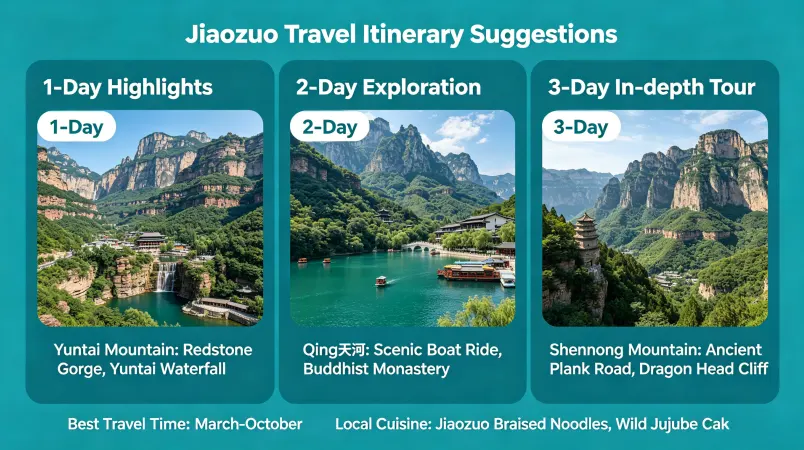
Suggested Itineraries for Jiaozuo
2‑Day Classic Tour (Yuntai Mountain Focus)
- Day 1: Arrive in Jiaozuo. Afternoon: visit Red Stone Gorge, Macaque Valley, and Zifang Lake at Yuntai Mountain. Stay overnight at the Anshang Service Area.
- Day 2: Morning: visit Quanpu Gorge and Tanpu Gorge. Afternoon: climb Zhuyu Peak. Return in the evening.
3‑Day In‑Depth Tour (Yuntai Mountain + Qingtian River + Shennong Mountain)
- Day 1: Full day at Yuntai Mountain (Red Stone Gorge + Quanpu Gorge + Tanpu Gorge + Zhuyu Peak).
- Day 2: Morning: go to Qingtian River (boat ride on Daquan Lake + Guanyin Gorge). Afternoon: head to the accommodation near Shennong Mountain.
- Day 3: Morning: visit Shennong Mountain (Dragon Ridge Great Wall + Zijin Peak). Return in the afternoon.
4‑Day Culture & Nature Tour (Add Chenjiagou and Jiaying Temple)
Based on the 3‑day tour, add a fourth day: morning visit Chenjiagou (Tai Chi performance + experience class); afternoon visit Jiaying Temple; then return.
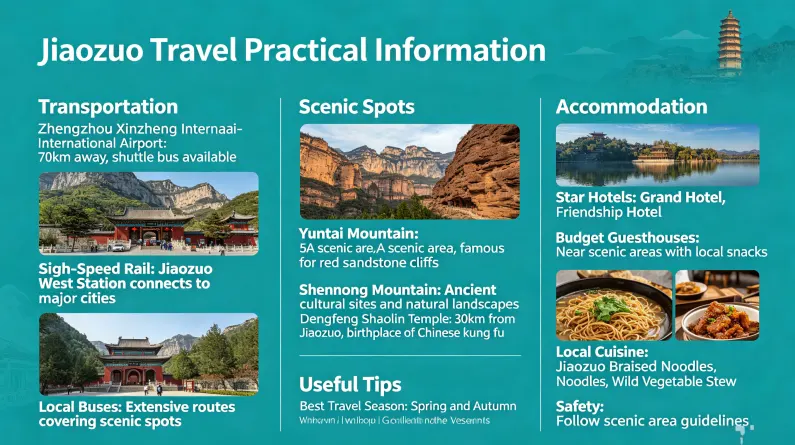
Practical Information Summary for Jiaozuo
Transportation
- Getting there: From Zhengzhou, take a high‑speed train to Jiaozuo Station or Jiaozuo West Station (about 50 minutes), then transfer to a tourist bus or taxi to the attractions.
- Local transport: Jiaozuo city has buses to Yuntai Mountain (Route 3) and Chenjiagou (toward Wen County). For Qingtian River, Shennong Mountain, and Jiaying Temple, it is recommended to take a private car or Didi – one way takes about 1–1.5 hours.
Accommodation
- Yuntai Mountain Anshang Service Area: The best choice for visiting Yuntai Mountain – many guesthouses.
- Jiaozuo city: Suitable for travelers using Jiaozuo as a base for multiple attractions. Recommended areas: Shanyang District and Jiefang District.
Best Time to Visit
- Yuntai Mountain, Qingtian River, Shennong Mountain: Spring (April–May) and autumn (September–October) are best. Summer has the most abundant water flow; winter offers snow and ice scenes.
- Chenjiagou, Jiaying Temple, Film and Television City: Good all year, just avoid public holidays.
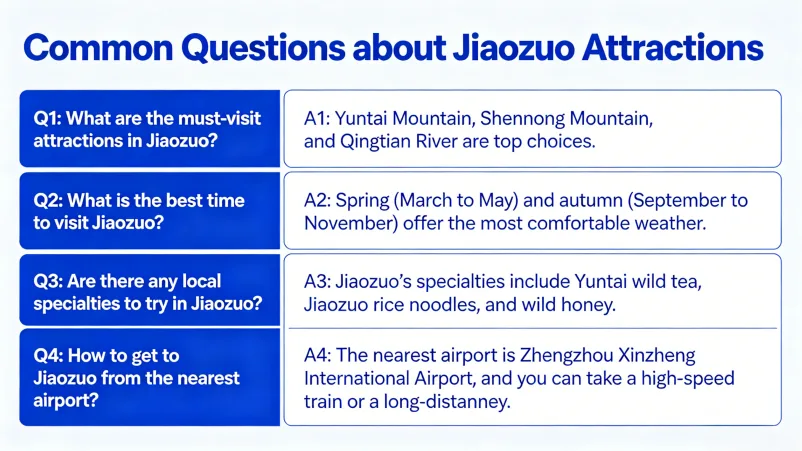
Frequently Asked Questions about Jiaozuo Attractions
Q: Which attraction in Jiaozuo is the most worthwhile?
A: Yuntai Mountain is the top choice – it is a UNESCO Global Geopark with unique landscapes. If time permits, add Qingtian River or Shennong Mountain.
Q: Can I learn Tai Chi at Chenjiagou?
A: Yes. Experience classes (1–2 hours) are available, taught by lineage holders. They need to be booked in advance and cost about 100–200 RMB.
Q: Are there direct shuttle buses between these attractions?
A: Yuntai Mountain has a shuttle bus to/from Jiaozuo city. For Qingtian River, Shennong Mountain, and Chenjiagou, you need to take a bus from Jiaozuo Tourist Bus Station or hire a private car.
Q: Are there ticket discounts for Jiaozuo attractions?
A: In 2026, with a Yuntai Mountain ticket, you can visit Shennong Mountain, Qinglong Gorge, and Fenglin Gorge for free within 7 days, and get 50% off at Qingtian River, Chenjiagou, and Jiaozuo Film and Television City. Keep your ticket stub.
Q: Is it convenient for foreign tourists to travel in Jiaozuo?
A: Major attractions have English signs, but public transportation and restaurants have low English availability. Use translation apps and Didi, and plan your itinerary.
Final Words
Jiaozuo is a low‑key city full of hidden treasures. It amazes the world with the red canyons and waterfalls of Yuntai Mountain, soothes the soul with the calm lake of Qingtian River, challenges your courage with the Dragon Ridge Great Wall at Shennong Mountain, shares Eastern wisdom through Tai Chi in Chenjiagou, and tells stories of history at Jiaying Temple. Whether you are a nature lover, a martial arts enthusiast, or a seeker of history and culture, Jiaozuo offers a rich and profound travel experience.
Plan your trip to Jiaozuo and explore these gems at the foot of the Taihang Mountains!
Related Reading:
- Yuntai Mountain Guide 2026: Red Stone Gorge, Waterfall & Itinerary
- Jiaozuo Food Guide 2026: Must-Try Dishes, Huai Mansion Donkey Meat & Iron Yam
- Jiaozuo Travel Guide 2026: Yuntai Mountain, Tai Chi Village & Itinerary
- Henan Travel Guide 2026: Itinerary, Attractions & Tips for Foreigners
- What is the Specialty of Henan Food? A Foreigner’s Guide to Henan Cuisine
- 2026 Henan Travel Guide: Top Attractions in Zhengzhou, Dengfeng & Kaifeng
- Zhengzhou Transportation Guide 2026: Metro, DiDi & Tips for Foreigners
- Zhengzhou 3-Day Itinerary: Shaolin Temple & Top Attractions (2026)
- Zhengzhou Food Guide: Must-Try Dishes Like HuiMian & HuLaTang (2026)
- What to do around Zhengzhou?