
Luoyang Travel Guide 2026: Top Attractions, Food & Tips for Foreigners
Luoyang Travel Guide 2026
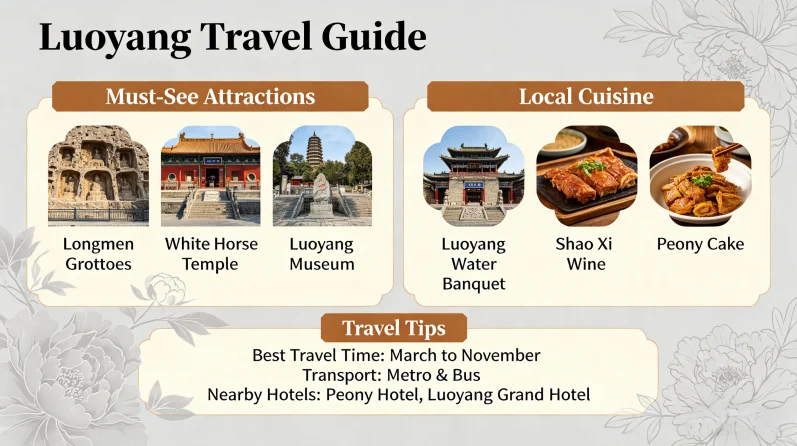
Luoyang is located in western Henan Province, on the banks of the Yellow River. It is the ancient capital with the longest history and the most dynasties in China. Starting from the Xia dynasty, thirteen dynasties made Luoyang their capital, giving it a history of over 1,500 years as a capital city. The city is famous worldwide for the Longmen Grottoes, the Luoyang Water Banquet, the Peony Festival, and the White Horse Temple. For foreign travelers, Luoyang is an ideal destination for exploring the origins of Chinese civilization. This guide provides complete information on transportation, attractions, food, accommodation, and itineraries to help you plan your Luoyang trip easily.
Why Choose Luoyang?
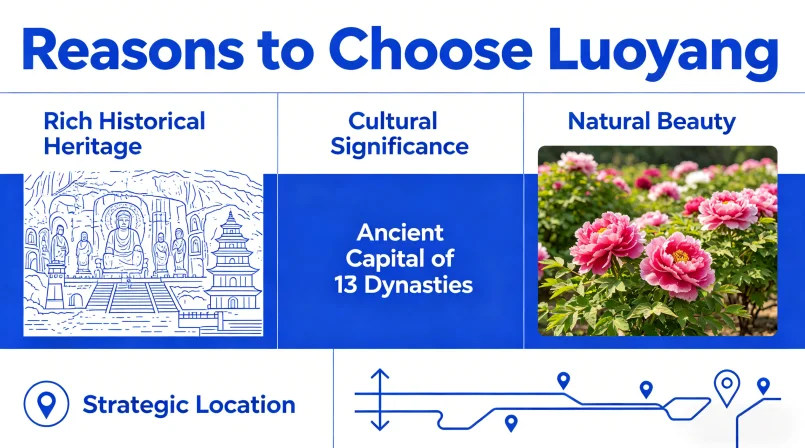
Luoyang is one of the cradles of Chinese civilization. Here you will find:
- Longmen Grottoes (UNESCO World Heritage) – the peak of Chinese stone carving art.
- White Horse Temple – the first officially built Buddhist temple in China, known as the “Source of Buddhism.”
- Sui and Tang Dynasties Luoyang City National Heritage Park – a rare capital ruins site.
- Luoyang Water Banquet and Peony Festival – famous around the world.
Compared to first‑tier cities like Beijing and Shanghai, travel costs in Luoyang are lower, but the cultural experience is extremely deep. Whether you are a history lover, a foodie, or a photography enthusiast, Luoyang will not disappoint you.
Best Time to Visit Luoyang
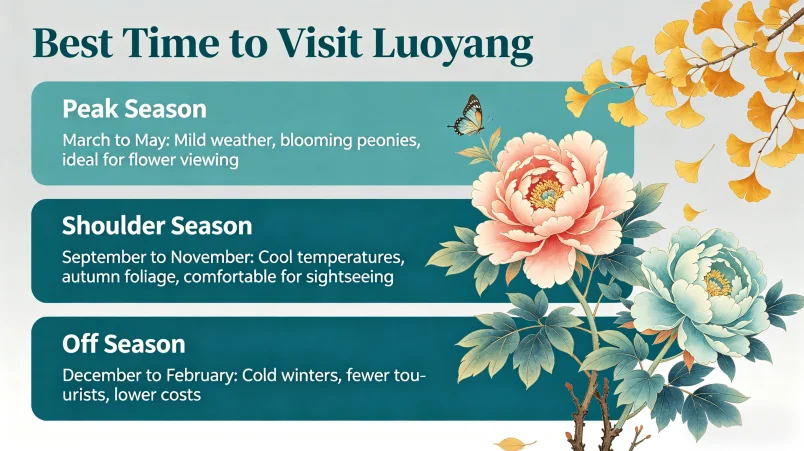
- Best seasons: Spring (April–May) and Autumn (September–October). Temperatures range from 15–25°C (59–77°F) and the weather is pleasant.
- Peony Festival: Held from April 1 to around May 10 each year. The city’s parks and streets bloom with peonies. However, the city is very crowded, and hotel prices double – book well in advance.
- Summer (June–August): Hot and rainy, but the night tours of Longmen Grottoes are very popular. Go out early and return late, and protect yourself from the heat.
- Winter (November–February): Cold and dry, with few tourists. This is a good time for museums and hot springs.
- Avoid: Chinese public holidays (National Day Golden Week, Oct 1–7, May Day, and Spring Festival). Attractions become extremely crowded, and accommodation is hard to find.
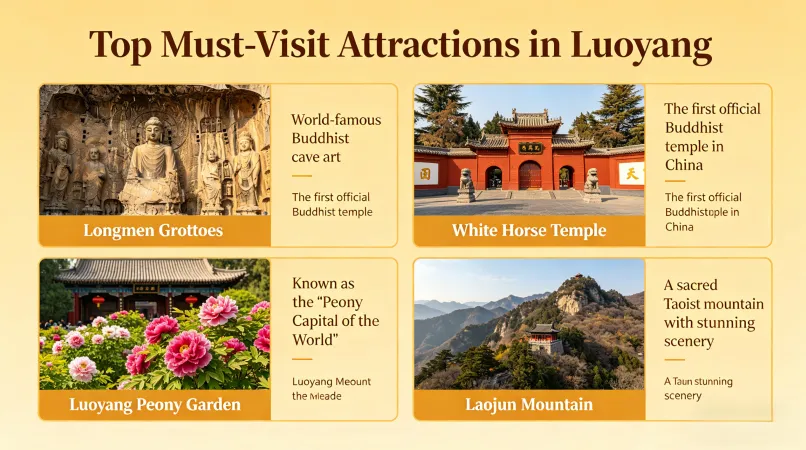
Must‑See Attractions in Luoyang
Longmen Grottoes – UNESCO World Heritage Site
The Longmen Grottoes are one of the four great grottoes in China. Carving began in the year 493 AD during the Northern Wei dynasty and continued for over 400 years through the Eastern Wei, Western Wei, Northern Qi, Sui, Tang, and Northern Song dynasties. Today, there are more than 2,300 niches, over 100,000 Buddhist statues, and 2,800 inscriptions.
Must‑see highlights:
- Vairocana Buddha at Fengxian Temple – 17.14 meters tall. It is said to have been carved in the likeness of Empress Wu Zetian. The Buddha has a kind face and a slight smile – this is the symbol of Longmen Grottoes.
- Binyang Three Caves – Representative caves from the Northern Wei period. They contain beautiful reliefs of “Emperor and Empress Paying Homage to the Buddha” (the originals were stolen and are now in the United States; what you see are replicas).
- Guyang Cave – The earliest cave at Longmen. It preserves many Northern Wei statues and fine calligraphy works known as the “Twenty Products of Longmen.”
- Xiangshan Temple – Located on the east mountain. The Tang dynasty poet Bai Juyi once lived here.
- Bai Garden – The tomb garden of Bai Juyi, a quiet and elegant place.
Practical information:
- Ticket: 90 RMB (includes West Hill Grottoes, East Hill Grottoes, Xiangshan Temple, and Bai Garden). Night tour requires a separate ticket.
- Opening hours: 8:00 – 18:00 (until 18:30 in summer; night tour until 21:00).
- Visit duration: At least 3–4 hours.
- Suggested route: Enter from the West Hill entrance, walk along the west bank of the Yi River, cross the bridge to the East Hill Grottoes, Xiangshan Temple, and Bai Garden, then exit from the east bank.
- Tip: Wear comfortable walking shoes because there are many steps. You can rent an English audio guide (30 RMB) or hire an English‑speaking guide.
White Horse Temple – The First Buddhist Temple in China
White Horse Temple was built in 68 AD during the Eastern Han dynasty. It is the first officially built Buddhist temple in China and is respected by Buddhists as the “Source of Buddhism” and the “Ancestral Court.” The temple’s name comes from the story of the “white horse carrying the sutras” – two Indian monks carried Buddhist scriptures and statues on a white horse to Luoyang.
Must‑see highlights:
- Mountain Gate – Ming dynasty architecture. The two stone horses on both sides are from the Song dynasty.
- Daxiong Hall – Contains Yuan dynasty dry‑lacquer statues (the Three Buddhas, two heavenly generals, and eighteen arhats) – these are national treasures.
- Qiyun Pagoda – A brick pagoda rebuilt in the Jin dynasty, about 25 meters high. It is the oldest existing ancient building in Luoyang.
- International Buddhist Temple Area – Recently built Thai, Indian, and Myanmar-style temples. They look very different and are great for photos.
Practical information:
- Ticket: 35 RMB.
- Opening hours: 7:30 – 18:00.
- Visit duration: About 2–3 hours.
- Transportation: Located in Luolong District. Take a taxi from downtown (about 20 minutes) or bus 56 or 58.
Luoyang Museum – A Window to the Ancient Capital
Luoyang Museum is a national first‑level museum, with a collection of over 400,000 cultural relics. It is most famous for its bronze ware, Tang tri‑color glazed pottery (sancai), and stone carvings.
Must‑see highlights:
- Erlitou culture exhibition (Xia dynasty) – Includes China’s earliest bronze jue (ritual vessel) and a dragon‑shaped object made of turquoise pieces.
- Tang sancai special exhibition – Many pieces with vivid shapes, including the famous “Tang sancai camel carrying musicians.”
- Stone carving hall – Eastern Han stone bixie (mythical beast), Northern Wei stone sarcophagus, etc.
Practical information:
- Ticket: Free, but you must make a reservation in advance on the official WeChat public account (use your passport).
- Opening hours: 9:00 – 17:00 (closed on Mondays).
- Visit duration: About 2–3 hours.
- Transportation: Located at Wenbo Road, Luolong District. Take Metro Line 2 to “Wenbo Park” station.
Sui and Tang Dynasties Luoyang City National Heritage Park
This area was the core of the capital during the Sui and Tang dynasties. Some buildings have been reconstructed on the ruins to give you a direct sense of the grandeur of the Tang imperial palace.
Main attractions:
- Bright Hall (Mingtang) – The main hall of the imperial palace during Wu Zetian’s reign, called the “Hall of Ten Thousand Spirits.” Inside, there are ruin displays and performances.
- Heaven Hall (Tiantang) – The place where Wu Zetian worshipped Buddha. It is 88 meters tall, and you can go to the top for a panoramic view of Luoyang.
- Yingtian Gate – The south gate of Sui‑Tang Luoyang city, where major national ceremonies were held. There is a light show at night.
Practical information:
- Ticket: Combined ticket for Bright Hall and Heaven Hall: 120 RMB. Yingtian Gate: 60 RMB.
- Opening hours: 8:30 – 21:00 (check the daily schedule for the light show).
- Visit duration: About 2 hours for Bright Hall + Heaven Hall, about 1 hour for Yingtian Gate.
- Transportation: Located at Zhongzhou Middle Road, Xigong District. Take Metro Line 1 to the “Yingtian Gate” station.
Guanlin Temple – Where Guan Yu’s Head is Buried
Guanlin Temple is the burial place of the head of Guan Yu, a famous general from the Three Kingdoms period. It is the only ancient architectural complex in China that combines a tomb, a temple, and a forest in one place. Guan Yu is honored as the “Saint of War,” equal to Confucius.
Highlights: Ming dynasty buildings, Guan Yu’s tomb, and steles from various dynasties.
Practical information:
- Ticket: 40 RMB. Visit duration: about 1–1.5 hours.
- Location: Guanlin Town, Luolong District. Take bus 15 or 39.
Luoyang Old Town and Cross Street Night Market
The old town of Luoyang preserves the street layout from the Ming and Qing dynasties. Lijing Gate is the west gate of the old city – climb it for a panoramic view. Passing through Lijing Gate, you enter East‑West Street, lined with snack shops and craft stalls.
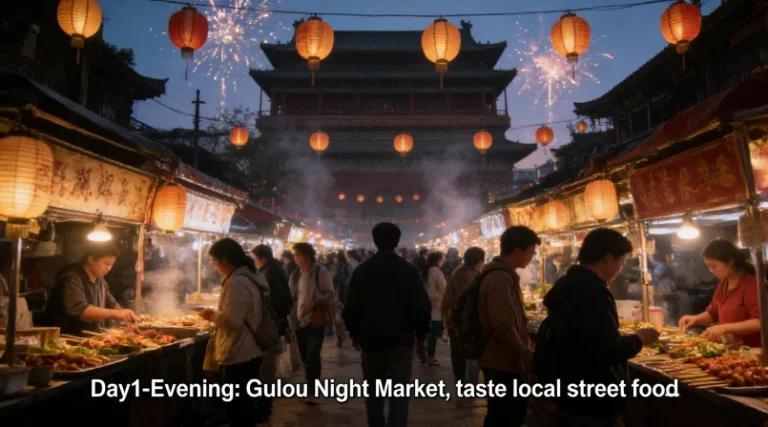
Cross Street Night Market: Starting around 18:00, hundreds of stalls gather here. This is the best place to taste Luoyang snacks.
Must‑try snacks:
- Bu fan soup (a sour and spicy soup)
- Jiang mian tiao (fermented soybean noodles)
- Tang mian jiao (steamed dumplings with soup inside)
- Peony silver silk candy (sweet pulled candy with peanuts and sesame)
Opening hours: Approximately 18:00 – 24:00 every day.
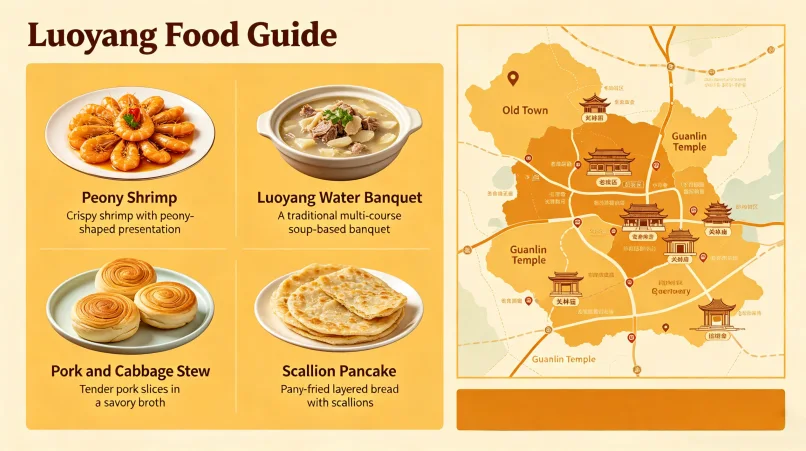
Luoyang Food Guide
Luoyang cuisine belongs to the Yu (Henan) culinary tradition, characterized by soups and broths and a savory flavor. Don’t miss these dishes:
- Luoyang Water Banquet – A feast from the Tang dynasty, with 24 dishes served in sequence: cold and hot, meat and vegetable, soup and solid dishes. The most famous is “Peony Yan Cai” – white radish threads shaped like a peony flower. Recommended restaurant: Zhen Bu Tong (an old and famous restaurant; you can order half a set or individual dishes).
- Bu fan soup – A sour and spicy soup made with mung bean jelly sheets, seaweed, small shrimp, etc. Recommended: Liu Ji Bu Fan Tang in the old town.
- Jiang mian tiao – Noodles cooked in fermented mung bean milk. It has a sour taste and is unique to Luoyang. Recommended: Lao Luoyang Noodle House in the old town.
- Tang mian jiao – Similar to steamed dumplings, with thin skin and juicy filling. Recommended: Ma Jia Tang Mian Jiao in the old town.
- Peony silver silk candy – Maltose pulled into fine threads and wrapped with peanuts and sesame. Sweet but not greasy. You can buy it at the night market.
Night market recommendation: Cross Street Night Market in the old town is the first choice – it brings together almost all Luoyang snacks. Xigong Xiao Jie also has many time‑honored shops.
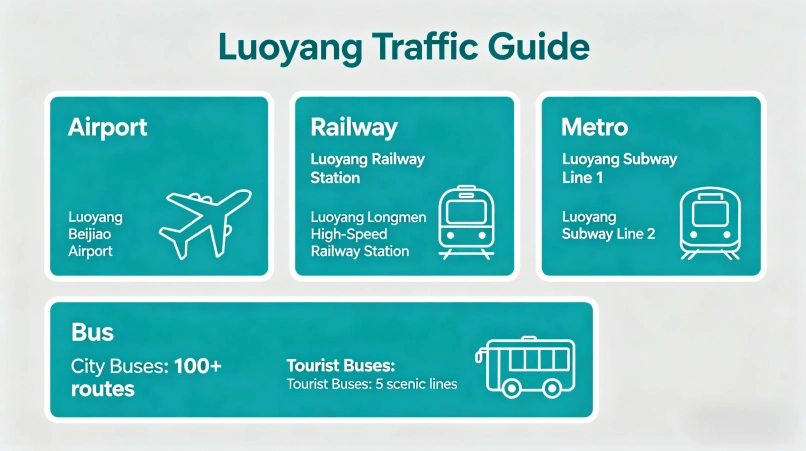
Transportation in Luoyang
Getting to Luoyang
- Plane: Luoyang Beijiao Airport has a few domestic flights and international charters. Most foreign travelers fly to Zhengzhou Xinzheng International Airport and then take a high‑speed train or bus to Luoyang.
- High‑speed train: Luoyang Longmen Station is a high‑speed rail station. From Zhengzhou East Station, it takes about 30–40 minutes, from Xi’an about 1.5 hours, and from Beijing about 3.5 hours.
- Regular train: Luoyang Station is in the city center, with regular‑speed trains to many cities.
- Long‑distance bus: Frequent buses from Zhengzhou Central Bus Station to Luoyang, travel time about 2.5 hours.
Getting around Luoyang
- Metro: Luoyang has two metro lines (Line 1 and Line 2). Line 1 connects Luoyang Station, Yingtian Gate, Lijing Gate, and the old town. Line 2 connects Luoyang Longmen Station, Luoyang Museum, and Citizens’ Home. Fare: 2–6 RMB.
- Taxi / ride‑hailing: Starting fare is 7–8 RMB. From downtown to Longmen Grottoes: about 25 RMB; to White Horse Temple: about 30 RMB. Didi Chuxing is available.
- Bus: Fare 1 RMB. Buses cover all attractions, but there may be no English announcements. Use Baidu Maps or Gaode Maps (Amap) to plan routes.
- Shared bikes: Meituan and Hellobike bikes are everywhere – good for short rides.
- Tourist buses: During peak season, there are tourist buses from Luoyang Station / Longmen Station to Longmen Grottoes and White Horse Temple.
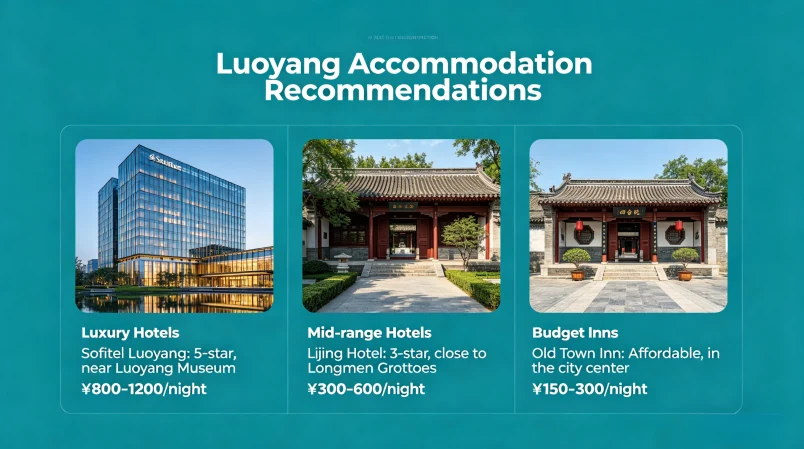
Accommodation in Luoyang
Based on your itinerary and budget, here are the recommended areas:
- Xigong District (near Yingtian Gate, Bright Hall, Heaven Hall) – City center, convenient transport, many restaurants. Budget hotels: 150–300 RMB/night; mid‑to‑high end: 300–600 RMB.
- Luolong District (near Longmen Grottoes, Luoyang Museum) – Newer environment, many high‑end hotels. Prices similar to Xigong.
- Old Town District (near Lijing Gate, Cross Street Night Market) – Lively, right next to the night market. Mainly budget hotels and boutique guesthouses: 150–250 RMB/night.
- Near Luoyang Longmen Station – Convenient for early high‑speed trains, but fewer shops and restaurants nearby.
Booking tip: Use Booking.com, Agoda, or Trip.com. Make sure to check the “foreigners accepted” filter.
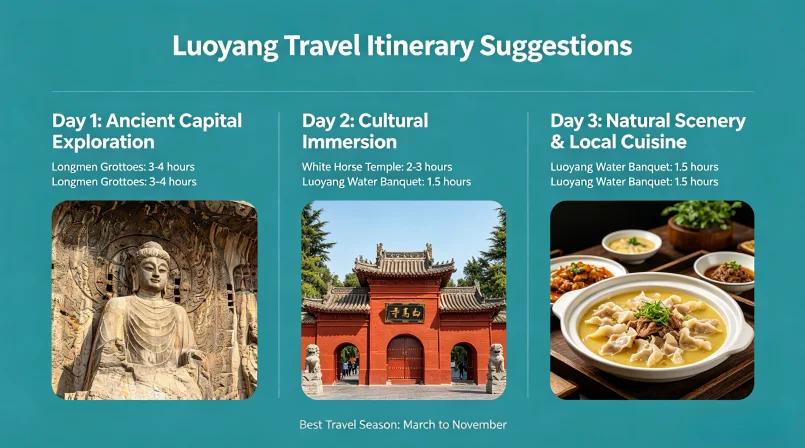
Suggested Itineraries for Luoyang
One‑Day Tour
- Morning: Longmen Grottoes (4 hours)
- Lunch: Near Longmen or back in the city
- Afternoon: White Horse Temple (2 hours) → Luoyang Museum (2 hours, optional)
- Evening: Cross Street Night Market in the old town (2 hours), then return
Two‑Day Tour
- Day 1: Morning – Longmen Grottoes → Lunch → Afternoon – Guanlin Temple (1.5 hours) → Sui‑Tang Luoyang City Heritage Park (Bright Hall + Heaven Hall + Yingtian Gate, 2.5 hours) → Evening – Xigong Xiao Jie or a night market.
- Day 2: Morning – White Horse Temple (2 hours) → Luoyang Museum (2 hours) → Afternoon – Lijing Gate, East‑West Street (1.5 hours) → Evening – Cross Street Night Market.
Three‑Day Tour
Add one more day to the two‑day tour:
- Day 3: Visit Luoyang Ancient Art Museum (formerly the Ancient Tombs Museum) – free entry, displays murals from ancient tombs. Or go to the Yellow River Xiaolangdi Scenic Area (view the grand Yellow River; in summer, you can see the spectacular water and sediment release). Or attend the Peony Festival (only in April).
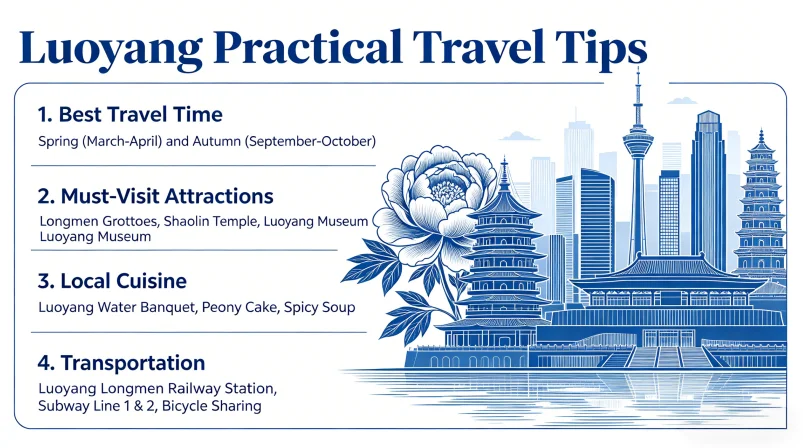
Practical Travel Tips for Luoyang
Language & Communication
Major attractions and high‑speed rail stations have English signs. Most local restaurants and taxi drivers speak only Chinese. Download Google Translate or Microsoft Translator and pre‑download the offline Chinese pack. Learn a few key words: hello (nǐ hǎo), thank you (xiè xie), how much (duō shǎo qián), this one (zhè ge).
Payment & Money
WeChat Pay and Alipay are almost everywhere. Strongly recommend linking your international credit or debit card to these apps before you go. Also carry a small amount of cash (200–300 RMB) for night markets, small vendors, and public toilets. 1, 5, and 10 RMB notes are most useful. Credit cards are accepted only at high‑end hotels and malls.
Internet & SIM Cards
You can either use international roaming (expensive but easy) or buy a short‑term SIM card (7, 15, or 30 days) from China Mobile, China Unicom, or China Telecom at the airport or official stores. Price: about 50–150 RMB. Show your passport. Hotels and restaurants usually provide free Wi‑Fi.
Safety & Health
Luoyang is very safe, but in crowded places like night markets and attractions, watch your belongings. Do not drink tap water – buy bottled water. In summer, bring insect repellent; in winter, bring moisturizer. We recommend buying travel insurance that covers China.
Tickets & Reservations
For popular attractions like Longmen Grottoes and Luoyang Museum, it is best to book tickets in advance on official WeChat public accounts or platforms like Ctrip (Trip.com) and Meituan to avoid waiting in line.
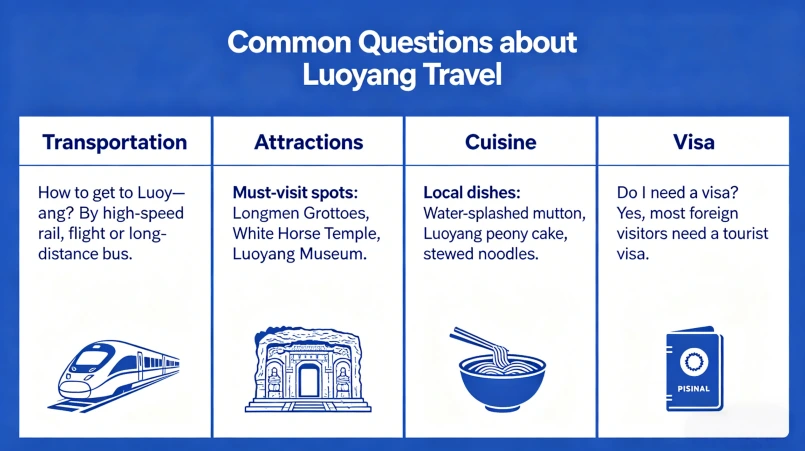
Frequently Asked Questions about Luoyang
Q: How many days do I need for Luoyang?
A: At least 2 days to cover the core attractions. 3 days allow a more relaxed experience of the old town and the surrounding areas.
Q: Is the Peony Festival worth going to?
A: Absolutely worth it, but you must be prepared for huge crowds. Choose a weekday in mid‑April (peak bloom) and book your hotel three months in advance.
Q: Can I visit Longmen Grottoes at night?
A: Yes. The night tour is very dreamlike with the grottoes lit up. However, the night tour ticket is separate and does not include daytime access inside the caves.
Q: What are good souvenirs from Luoyang?
A: Tang sancai (small crafts), peony cakes, peony flower tea, Luoyang palace lanterns, and Dukang wine.
Q: How common is English in Luoyang?
A: Attractions like Longmen Grottoes and White Horse Temple have English signs and guides. Hotel front desks can speak basic English. Taxi drivers and night market stall owners generally do not.
Final Words
Luoyang is a city where “everywhere is history.” Here, you can stand before the Longmen Grottoes and feel the devotion of ancient craftsmen, listen to the first echoes of Buddhist teachings at White Horse Temple, imagine the majesty of Empress Wu Zetian at the Bright Hall and Heaven Hall, and taste flavors passed down for a thousand years in the lively atmosphere of Cross Street Night Market. Luoyang does not impress you with noise – instead, with its depth and calmness, it lets you slowly understand China.
Plan your trip to Luoyang and begin a journey through the ancient capital of the thirteen dynasties!
Related Reading:
- Henan Travel Guide 2026: Itinerary, Attractions & Tips for Foreigners
- Shaolin Temple Day Trip 2026: Complete Guide & Tips
- Kaifeng Food Guide 2026: Top 10 Must-Try Dishes
- What is the Specialty of Henan Food? A Foreigner’s Guide to Henan Cuisine
- Shaolin Temple Day Trip from Zhengzhou: 2026 Ultimate Itinerary & Tips
- Zhengzhou Travel: Top Things to Do in China’s Central Plains
- Zhengzhou travel guide