
Jiaozuo Food Guide 2026: Must-Try Dishes, Huai Mansion Donkey Meat & Iron Yam
Jiaozuo Food Guide 2026
Jiaozuo, a city at the southern foot of the Taihang Mountains, was known as Huaiqing Prefecture in ancient times. It is where the Yellow River culture meets the products of the Taihang Mountains. Besides the magnificent scenery of Yuntai Mountain, Jiaozuo has developed a unique and deep food culture. Jiaozuo cuisine is represented by the “Four Huai Medicines” (Huai rehmannia, Huai achyranthes, Huai yam, and Huai chrysanthemum), as well as donkey meat, oil tea, and other traditional flavors. The cooking emphasizes long‑simmered broths and the integration of food and medicine, with simple, rich tastes. For foreign travelers, exploring Jiaozuo’s food is a taste journey into the rural and health‑conscious culture of Central China. This guide recommends the most authentic Jiaozuo specialties, where to find them, and practical tips.
Three Special Features of Jiaozuo Food
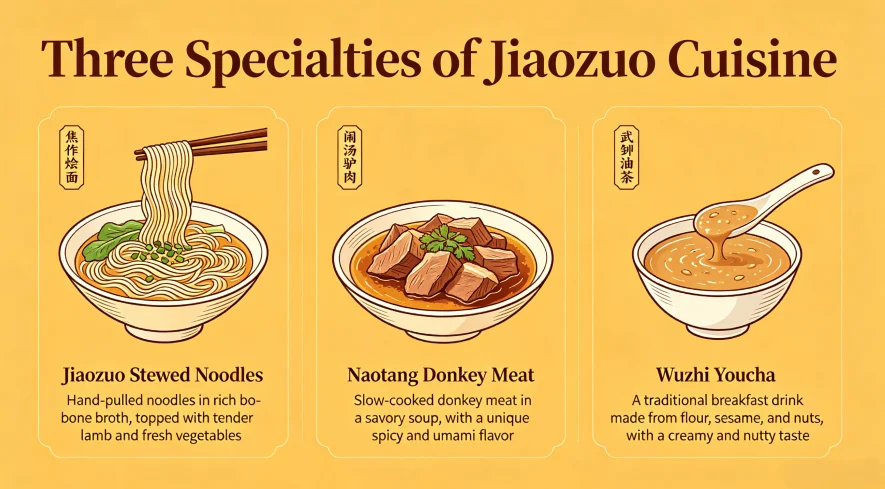
Jiaozuo was called Huaiqing Prefecture in ancient times, and its food culture is deeply influenced by the “Huai Medicines.” Local cooks are good at incorporating yams, rehmannia, and other medicinal ingredients into daily dishes to achieve the effect of “food and medicine sharing the same source.” Second, long‑simmered broths are the essence of Jiaozuo cooking. Whether it is Simmered Donkey Meat or Wuzhi Clay Pot Stew, they all use dozens of spices and bones boiled for many hours to create a rich flavor. Finally, Jiaozuo is in northern China, so wheat‑based foods are abundant – stretched noodles, fried noodles, and oil tea are daily staples for locals.
Must‑Try Jiaozuo Dishes
Huai Mansion Simmered Donkey Meat – A Century‑Old Delicacy
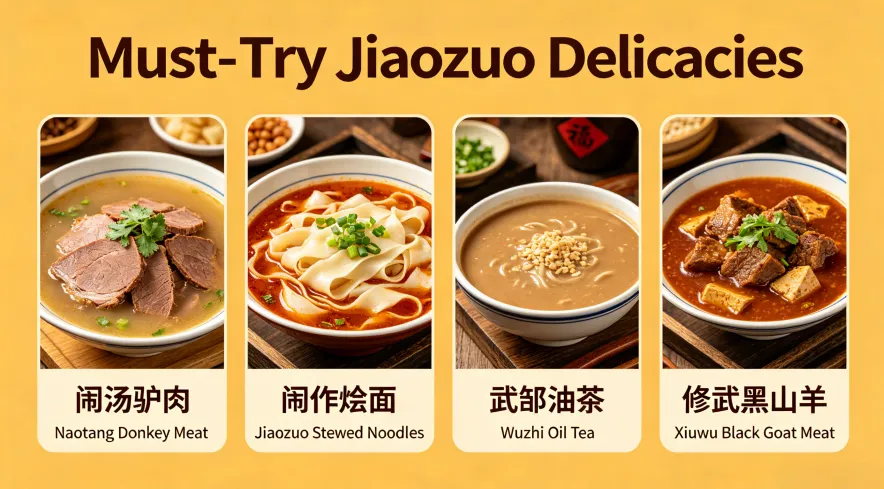
Huai Mansion Simmered Donkey Meat is a hundred‑year specialty of Qinyang City, Jiaozuo. It is considered the best example of the saying: “Dragon meat in the sky, donkey meat on earth.” “Simmering soup” (nào tāng) refers to a constantly boiling broth made with donkey bones and more than 30 spices, aged for decades or even centuries to become a master stock. Fresh donkey meat is slowly simmered in this soup. The cooked meat is red, tender, and melts in the mouth, with no unpleasant smell.
- How to eat: Cut into thin slices, dip in garlic vinegar sauce and chili oil, or put inside a baked flatbread to make a donkey meat burger.
- Recommended places: Dong Guoqing Donkey Meat Restaurant in Qinyang city; Huai Mansion Donkey Meat Feast in Jiaozuo city.
- Price: About 60–80 RMB per 500 grams; a cold plate of donkey meat costs about 40–50 RMB.
Iron Stick Yam (Tiegun Shanyao) – A “Ginseng” from Huai Region
Iron Stick Yam is a specialty of Wen County, Jiaozuo. It is named for the rust‑like spots on its skin and is a National Geographical Indication product. Known as “Huai ginseng,” it has high nutritional value. The flesh is firm and does not fall apart after long cooking. When steamed, it tastes soft and powdery, with a light chestnut sweetness. People in Jiaozuo use yams in many dishes, from main courses to desserts.
- Classic preparations:
- Candied Yam (Ba Si Shanyao): Deep‑fried yam pieces coated in sugar syrup that forms golden threads – crispy outside, soft inside.
- Blueberry Yam: Steamed yams mashed and topped with blueberry sauce – sweet and sour.
- Yam and Pork Rib Soup: Clear broth with pork ribs and yam; the yam absorbs the meat flavor – delicious and nourishing.
- Recommended places: Most local restaurants in Jiaozuo city, such as Huai Mansion Feast and Lao Dongjia Donkey Meat Restaurant.
- Souvenirs: Fresh Iron Stick Yam from Wen County (vacuum‑packed – check customs regulations), or processed products like yam powder and yam crisps.
Wuzhi Oil Tea – An Imperial Health Paste
Wuzhi Oil Tea is a traditional snack of Wuzhi County, Jiaozuo, with a history of over 2,000 years. It is said to have appeared in the Han dynasty and was a tribute to the imperial court in the Qing dynasty. It is not a “tea” but a thick paste made by stir‑frying flour, sesame, peanuts, walnuts, and other nuts and spices, then boiling it with water. It is fragrant, salty, and delicious – both warming and filling.
- How to eat: Usually eaten for breakfast. Order a bowl by itself or with fried dough sticks or flatbreads.
- Recommended places: Breakfast shops in Jiaozuo city, or the Wuzhi Oil Tea Main Store (Jiefang District, Jiaozuo).
- Price: About 5–10 RMB per bowl.
Haichan Palace Preserved Egg – Royal Egg from the Song Dynasty
Haichan Palace Preserved Eggs are produced in Wuliyuan, Xiuxiu County, Jiaozuo. They have a history of over 800 years. Legend says the Song dynasty imperial court listed them as a tribute. The eggs are made by wrapping duck eggs with ashes from local pine and cypress branches, then curing them using a special process. The finished egg white is crystal clear with pine‑needle‑like patterns (“pine flowers”). The yolk is soft and dark green. The taste is light and fresh with a special aroma – not as strong as ordinary preserved eggs.
- How to eat: Peel and cut into pieces, dip in ginger vinegar sauce or soy sauce and chili oil. Also good in cold tofu dishes or preserved egg and tofu salad.
- Where to buy: Specialty shops in Wuliyuan Village, Xiuxiu County, or supermarkets in Jiaozuo city.
Bo’ai Mixed Stew (Zaban) – A Deluxe Braised Dish
Bo’ai Mixed Stew is a traditional braised dish from Bo’ai County, Jiaozuo. More than ten ingredients – including crispy pork slices, meatballs, wood ear mushrooms, bamboo shoots, tofu skin, tofu, and vegetables – are prepared separately and then braised together in rich broth. The broth is thick, the ingredients are abundant, and the taste is savory. It is a very satisfying dish to go with rice.
- Recommended places: Time‑honored Zaban restaurants in Bo’ai county town, or Henan cuisine restaurants in Jiaozuo city.
- Price: About 30–50 RMB per serving (serves 2–3 people).
Qinghua Stretched Noodles – Hand‑Pulled, Chewy Noodles
Qinghua is the old name for Bo’ai County. Qinghua Stretched Noodles are the most representative noodle dish in the area. The dough is repeatedly stretched by hand to form wide, uneven noodles that are very chewy. The broth is made from mutton or beef, with greens, wood ear mushrooms, and tofu skin. It can also be served as oil‑splashed noodles or with fried bean sauce.
- Recommended places: Old Qinghua noodle shops in Bo’ai county town. In Jiaozuo city, Zhengzhou Huimian noodle shops offer a similar style.
- Price: About 12–18 RMB per bowl.
Mengzhou Fried Noodles – Dry, Crispy, and Aromatic
Mengzhou Fried Noodles are different from common braised noodles. Raw noodles are first pan‑fried until golden and crispy on both sides, then stir‑fried with bean sprouts, greens, shredded meat, and other ingredients. The texture is dry, crispy, and very chewy.
- Recommended places: Time‑honored fried noodle shops in Mengzhou city; Mengzhou Fried Noodle King in Jiaozuo city.
- Price: About 15–20 RMB per serving.
Jiaozuo Baked Flatbread (Shaobing) – Daily Staple Baked in a Charcoal Oven
Jiaozuo flatbread is similar to flatbreads in other regions but emphasizes a crispy texture. Made from unleavened dough and baked against the inner wall of a clay oven, the outside is golden brown and crispy, the inside soft. It can be stuffed with tofu skewers, braised egg, or beef.
- Recommended places: Street stalls in Jiaozuo city, especially around Heping Street and Minzhu Road.
- Price: 1 RMB for plain flatbread; 3–5 RMB with fillings.
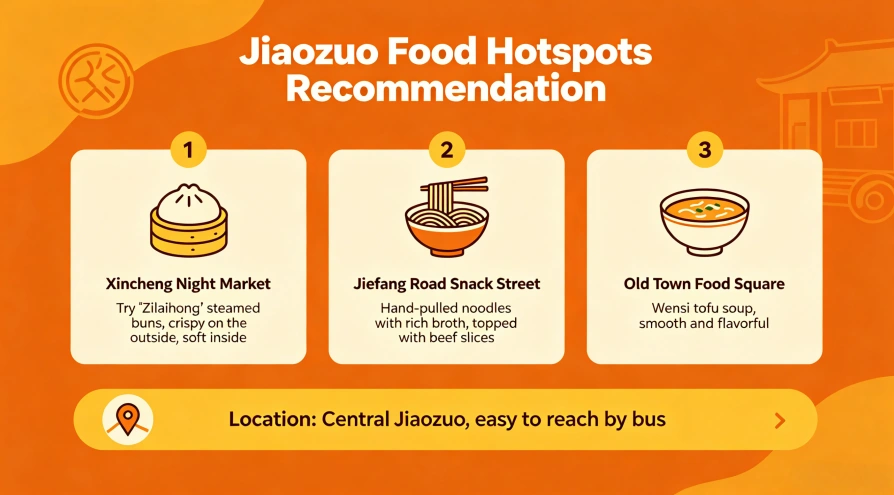
Recommended Food Gathering Places
Jiaozuo City
- Fengshou Road Food Street, Shanyang District: Many local restaurants and night market stalls serving Simmered Donkey Meat, Iron Stick Yam, Mixed Stew, and more.
- Minzhu Road Night Market, Jiefang District: Opens in the evening, mainly snacks and barbecue – great for experiencing local street life.
- Wanda Plaza (Jiaozuo): On the 4th floor, various restaurants with better ambiance – suitable for families.
Yuntai Mountain Anshang Service Area
Inside the Yuntai Mountain scenic area, the Anshang Service Area has many farm‑stay restaurants. Here you can taste wild mountain vegetables, free‑range chicken, Iron Stick Yam, preserved eggs, and other rustic flavors. Prices are slightly higher than in the city, but very convenient.
Qinyang City, Bo’ai County, Xiuwu County
If you want the most authentic Simmered Donkey Meat (Qinyang), Mixed Stew (Bo’ai), or Preserved Eggs (Xiuwu), it is recommended to go directly to the old‑brand shops in these county towns. It takes about 30–50 minutes by bus from Jiaozuo city.
Practical Tips
Taste and Spiciness
Jiaozuo dishes are generally savory, not spicy. Simmered Donkey Meat itself has no chili; chili oil is provided separately. Wuzhi Oil Tea is salty and fragrant, with no pepper spiciness. If you want spiciness, add chili oil or vinegar yourself.
Ordering Recommendations
- One person: A bowl of Qinghua Stretched Noodles (about 15 RMB) plus a small portion of cold donkey meat (about 20–25 RMB for a half portion).
- Two persons: One plate of Simmered Donkey Meat (about 60 RMB) + one plate of Candied Yam (about 35 RMB) + one plate of Bo’ai Mixed Stew (about 40 RMB) + flatbread or rice. Alternatively, one Wuzhi Clay Pot Stew (about 45 RMB) with flatbread.
- Souvenir combo: Vacuum‑packed Simmered Donkey Meat (about 80 RMB/bag) + Iron Stick Yam powder (about 50 RMB/can) + Wuzhi Oil Tea instant mix (about 20 RMB/bag).
Payment and Language
Restaurants and night markets all accept WeChat Pay and Alipay. Link an international credit or debit card in advance. For night market stalls, it is recommended to carry 50–100 RMB in cash. Some small restaurants do not have English menus – use a translation app or point at what the next table is eating.
Vegetarian Friendliness
Jiaozuo has many vegetarian options. Candied Yam, Blueberry Yam, stir‑fried mixed vegetables, scrambled eggs with edible fungus, Wuzhi Oil Tea (usually vegetarian), and preserved eggs are all vegetarian. When ordering, tell the server, “I am a vegetarian, no meat and no animal oil.”
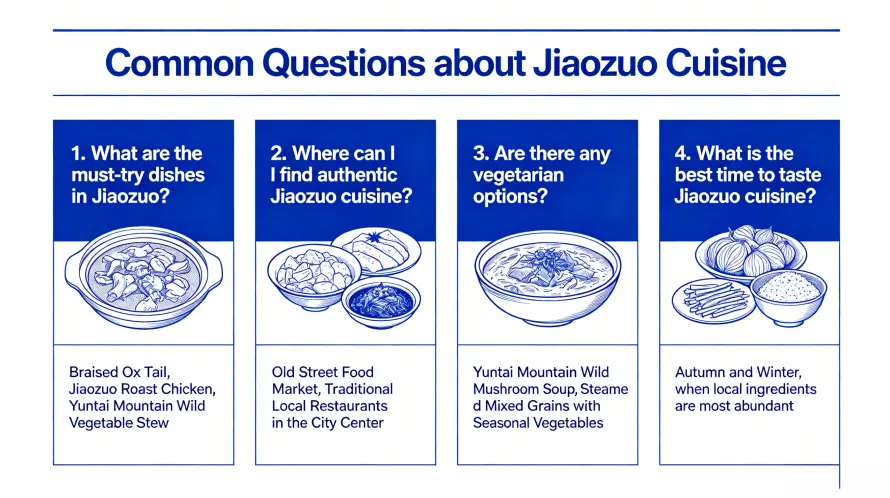
Frequently Asked Questions
Q: What does Simmered Donkey Meat taste like?
A: It is more tender than beef, has no smell like mutton, and is very delicate. The meat is finely textured, rich in braised flavor, and almost melts in the mouth when sliced thin.
Q: What is the difference between Iron Stick Yam and ordinary yams?
A: Iron Stick Yam is thinner and longer, with rust‑colored spots on the skin. It has a soft, powdery texture and does not break apart during long cooking. It also has higher nutritional value.
Q: Are preserved eggs raw? Can I eat them directly?
A: Preserved eggs are already cured and ready to eat. Just peel and slice them. They are usually dipped in ginger vinegar sauce or soy sauce. They are also used in preserved-egg and lean-pork congee or cold tofu salad.
Q: What are good breakfast choices in Jiaozuo?
A: Wuzhi Oil Tea with fried dough sticks or flatbread is the most authentic choice. You can also have mutton soup or beef soup.
Q: Where can I buy Jiaozuo specialties?
A: Supermarkets in Jiaozuo city (such as Dennis and Yonghui) have specialty sections. Souvenir shops at the entrance of Yuntai Mountain also sell vacuum‑packed Simmered Donkey Meat, Iron Stick Yam, preserved eggs, and more. If bringing fresh yams home, check customs regulations.
Final Words
Jiaozuo food, like the landscapes of this city, is simple yet profound. From the Simmered Donkey Meat cooked in a century‑old master stock, to the “food‑as‑medicine” iron stick yams, to a warm bowl of Wuzhi Oil Tea on a street corner – every bite carries the wisdom of life in Huaiqing Prefecture over thousands of years. Whether you need to refuel after hiking Yuntai Mountain or come specifically for the food, Jiaozuo will touch your taste buds with its most genuine flavors.
May you see beautiful landscapes in Jiaozuo, and remember its tastes long after you leave.
Related Reading:
- Jiaozuo Travel Guide 2026: Yuntai Mountain, Tai Chi Village & Itinerary
- Henan Travel Guide 2026: Itinerary, Attractions & Tips for Foreigners
- What is the Specialty of Henan Food? A Foreigner’s Guide to Henan Cuisine
- Zhengzhou Food Guide: Must-Try Dishes Like HuiMian & HuLaTang (2026)
- What to do around Zhengzhou?
- 2026 Dengfeng Food Guide: Shaolin Veggie Delights & Local Snacks
- 2026 Luoyang Food Guide: Best Local Dishes, Water Banquet & Night Market Tips
- Dengfeng Travel Guide 2026: Shaolin Temple, Mount Song & Itinerary