
Hebi Attractions: Top 8 Must-Visit Places & Travel Guide 2026
Hebi, a city in northern Henan Province, may be unfamiliar to many foreign travelers, but it is rich in historical relics and magnificent natural scenery. It is the site of Zhaoge, the late Shang dynasty capital, and the core stage of the mythological story Investiture of the Gods. From the ancient military academy at Yunmeng Mountain to the giant stone Buddha at Xun County, from the poetic atmosphere of the Qi River to the legacy of the Medicine King at Wuyan Mountain, Hebi offers a unique experience away from the crowds and deep into Central Plains culture. This guide recommends the best attractions in Hebi and provides detailed practical information.

Why Choose Hebi
Hebi’s main appeal lies in its deep history and relatively peaceful travel atmosphere. There are not the crowds of Luoyang or Kaifeng, yet the historical stories are just as fascinating. You can visit Yunmeng Mountain, where the famous Warring States strategist Guiguzi lived in seclusion and taught – known as “China’s First Ancient Military Academy.” You can also visit Dapi Mountain, home to the largest Northern Wei stone Buddha in northern China. Xun County Ancient City and the Qi River are great places to experience life in a Central Plains ancient town and enjoy natural scenery. In addition, Zhaoge Ruins and Wuyan Mountain each have their own character, suitable for travelers with different interests.

Must‑Visit Attractions in Hebi
Yunmeng Mountain – China’s First Ancient Military Academy
Yunmeng Mountain is located in the western part of Qi County, Hebi, an extension of the Taihang Mountains. It is famous because Guiguzi (Wang Chan), a renowned military strategist of the Warring States period, lived here in seclusion and taught his disciples. Legend says that Sun Bin, Pang Juan, Su Qin, and Zhang Yi – famous strategists – all studied under him. Yunmeng Mountain is known as “China’s First Ancient Military Academy” and is one of the birthplaces of ancient Chinese military culture.
Core highlights:
- Guiguzi Temple: The core building of Yunmeng Mountain, dedicated to Guiguzi. Inside, displays introduce his life and the achievements of his disciples. You can learn how this legendary figure trained so many talents who shaped the Warring States period.
- Water Curtain Cave: The place where Guiguzi lived and taught. It is a natural cave with a clear spring flowing through it – cool in summer and warm in winter. Outside, a waterfall hangs like a curtain – a serene scene that seems to echo with lectures from over 2,000 years ago.
- Sun Bin Cave and Pang Juan Cave: Dedicated to two of Guiguzi’s famous disciples. Sun Bin was the inheritor of The Art of War, and Pang Juan was a general of the Wei state. Their story is a classic tale of wisdom and betrayal in ancient Chinese military history.
- Cliff Inscriptions: Yunmeng Mountain preserves many cliff carvings from the Song, Ming, and Qing dynasties — highly valuable for calligraphy and historical research.
Practical information:
- Ticket: About 60 RMB
- Opening hours: 8:00 – 17:30
- Recommended visit duration: Half a day to a full day
- Transport: About 40 minutes by taxi from Hebi City, or take a bus to Qi County.
Why you must go: Yunmeng Mountain is a sacred site of ancient Chinese military culture, perfectly combining natural scenery with historical relics – highly attractive to history lovers and hikers.
Dapi Mountain – The Largest Northern Wei Stone Buddha in the North
Dapi Mountain is located in Xun County, Hebi, and is a famous historical and cultural mountain. Its most famous feature is the Northern Wei Giant Buddha, 22.29 meters (73 feet) tall – the largest stone Buddha in northern China, even earlier than the Vairocana Buddha at Longmen Grottoes in Luoyang. Dapi Mountain also has ancient buildings such as the Ancestral Hall of Lu Dongbin, the Temple of Yu the Great, and Tianning Temple, blending Buddhism, Taoism, and Confucianism.
Core highlights:
- Northern Wei Giant Buddha: Carved during the Northern Wei dynasty, with a history of over 1,500 years. The Buddha is carved into the mountain, solemn and compassionate. Despite the passage of time, it remains well preserved. Standing before it, you can feel the devotion and skill of ancient craftsmen.
- Tianning Temple: The main temple on Dapi Mountain, with a scripture library and Grand Hall. Ancient cypresses tower around it – a quiet environment.
- Ancestral Hall of Lu Dongbin: Dedicated to Lu Dongbin, one of the Eight Immortals of Taoism – reflecting the mountain’s multicultural character.
- Temple of Yu the Great: Commemorates Yu the Great’s achievements in controlling floods – reflecting the deep influence of Yellow River culture in the Hebi area.
Practical information:
- Ticket: About 50 RMB
- Opening hours: 8:00 – 17:30
- Recommended visit duration: 2–3 hours
- Transport: Take a bus from Hebi City to Xun County – about 1 hour.
Why you must go: Dapi Mountain is a perfect combination of Buddhist art and natural scenery. The Northern Wei Giant Buddha is an unmissable cultural treasure.
Xun County Ancient City – Ming Dynasty City and Lunar New Year Temple Fair
Xun County Ancient City was first built in the Ming dynasty and is a National Historical and Cultural City. The city walls, old streets, and traditional houses are well preserved, showing the appearance of a Central Plains city during the Ming and Qing dynasties. Every year during the first lunar month, Xun County hosts the largest ancient temple fair in northern China, attracting millions of visitors.
Core highlights:
- Ancient City Wall: A well‑preserved Ming dynasty wall. You can climb it for a panoramic view of the ancient city. The gate towers and corner towers show the ancient military defense system.
- Wenzhi Pavilion: The central landmark of the ancient city, a Ming dynasty pavilion. Climb it for a full view of the old town.
- Old Streets: South Street and North Street retain the Ming and Qing layout, with traditional shops and houses on both sides – you can buy local specialties.
- Lunar New Year Temple Fair: If your visit coincides with the first lunar month, do not miss the Xun County Temple Fair. It features folk performances, traditional arts, snack stalls, and handicrafts – extremely lively.
Practical information:
- Ancient city entry: Free (some attractions charge separately)
- Opening hours: All day
- Recommended visit duration: Half a day
- Transport: Take a bus from Hebi city to Xun County – about 1 hour.
Why you must go: Xun County Ancient City is the best place to experience life in a Central Plains ancient town and traditional temple fair culture.
Qi River – The River in the Classic of Poetry
The Qi River is the mother river of Hebi and is mentioned many times in the Classic of Poetry (Shijing), China’s first collection of poetry. The water is clear, and the banks are beautiful – a paradise for walking and cycling.
Core highlights:
- Qi River Wetland Park: A national‑level wetland park with rich flora and fauna. You can walk along the riverside paths and enjoy reeds, lotus ponds, and flocks of wild ducks.
- Qi River Poetry Garden: Displays poems from the Classic of Poetry related to the Qi River, showing the river’s important place in Chinese literary history.
- Sangyuan Town: A characteristic town by the Qi River, combining leisure, dining, and guesthouses. You can try local dishes such as Qi River crucian carp.
Practical information:
- Entry: Free
- Opening hours: All day
- Recommended visit duration: 2–3 hours
- Transport: About 20 minutes by taxi from Hebi city.
Why you must go: The Qi River is a perfect place to enjoy Hebi’s natural beauty and literary heritage.
Zhaoge Ruins – The Last Capital of the Shang Dynasty
Zhaoge was the capital of King Zhou, the last ruler of the Shang dynasty, located in Qi County, Hebi. Although the above‑ground buildings no longer exist, the ruins still attract visitors interested in Shang history and the story of the Investiture of the Gods.
Core highlights:
- Zhaoge Ruins Park: Displays the history and culture of the Shang capital, with reconstructed palace foundations and unearthed artifacts.
- King Zhou’s Tomb: Said to be the burial place of King Zhou. Although small, it is historically significant.
- Investiture of the Gods Culture: Hebi is the core area of the Investiture of the Gods story. Many place names and legends are related to this mythological novel. Here you can learn about the background of characters such as Jiang Ziya, Nezha, and Daji.
Practical information:
- Ticket: About 30 RMB
- Opening hours: 8:00 – 17:30
- Recommended visit duration: 1.5–2 hours
- Transport: Take a bus from Hebi City to Qi County – about 40 minutes.
Why you must go: For visitors who love Chinese history and mythology, Zhaoge Ruins is an important place to learn about the Shang dynasty and the Investiture of the Gods culture.
Wuyan Mountain – The Retreat of the Medicine King Sun Simiao
Wuyan Mountain is located in Heshan District, Hebi. It is famous because Sun Simiao, a renowned physician of the Tang dynasty, lived here in seclusion, gathered herbs, made medicines, and wrote books. Sun Simiao was later honored as the “King of Medicine,” and his work Qianjin Fang (Essential Prescriptions Worth a Thousand Gold) is an important document in Chinese medical history. Wuyan Mountain has not only the Medicine King Cave and Medicine King Temple but also beautiful natural scenery and natural caves.
Core highlights:
- Medicine King Cave: The natural cave where Sun Simiao lived in seclusion. Inside, there are statues of him and stone carvings of prescriptions.
- Medicine King Temple: Dedicated to Sun Simiao. Every year on the 28th day of the fourth lunar month, a temple fair is held.
- Natural scenery: Wuyan Mountain is steep with high forest coverage – a great place for hiking and trekking.
Practical information:
- Ticket: About 40 RMB
- Opening hours: 8:00 – 17:30
- Recommended visit duration: 2–3 hours
- Transport: About 30 minutes by taxi from Hebi City.
Why you must go: Wuyan Mountain is an important site of traditional Chinese medicine culture, suitable for travelers interested in traditional medicine and natural scenery.
Hebi Cherry Blossom Avenue – A Romantic Sea of Flowers in Spring
Hebi Cherry Blossom Avenue is located on Huaxia South Road in Qibin District, about 4 km (2.5 miles) long, with tens of thousands of cherry trees planted. From late March to mid‑April each year, the cherry blossoms bloom, forming a pink and white corridor of flowers – one of Hebi’s most popular spring attractions.
Core highlights:
- Cherry Blossom Corridor: Tens of thousands of cherry trees bloom at the same time – a spectacular sight. You can stroll under the trees and enjoy the romantic falling petals.
- Night Cherry Blossoms: During the cherry blossom festival, the area is decorated with lights at night, giving the blossoms a special charm.
Practical information:
- Entry: Free
- Best time: Late March to mid‑April
- Recommended visit duration: 1–2 hours
- Transport: Located in Hebi city – reachable by taxi or bus.
Why you must go: If you visit Hebi in spring, Cherry Blossom Avenue is the best place to feel the city’s romantic atmosphere.
Temple of Bi Gan – The First Temple Under Heaven
The Temple of Bi Gan is located in Qi County, Hebi. It was built to commemorate Bi Gan, a loyal minister of the Shang dynasty. Bi Gan was the uncle of King Zhou and was killed by the king after speaking frankly. Later generations honored him as the “Eternal Loyal Minister,” and the temple is also called “The First Temple Under Heaven.” The temple preserves a stele inscribed by Emperor Xiaowen of the Northern Wei dynasty and inscriptions by scholars throughout history.
Core highlights:
- Bi Gan’s Tomb: The core of the temple. In front of the tomb is a sword‑carved stele attributed to Confucius – said to be the only surviving authentic work of Confucius.
- Ancient Architecture: The temple has a mountain gate, main hall, and stele corridor – simple and historic.
Practical information:
- Ticket: About 30 RMB
- Opening hours: 8:00 – 17:30
- Recommended visit duration: 1.5–2 hours
- Transport: About 15 minutes by taxi from Qi County town.
Why you must go: The Temple of Bi Gan is an important place to learn about China’s culture of loyal ministers and Shang dynasty history.

Suggested Itineraries
1‑Day Essential Tour (Yunmeng Mountain + Zhaoge Ruins + Temple of Bi Gan)
- Morning: Yunmeng Mountain (4 hours)
- Afternoon: Zhaoge Ruins (1.5 hours) → Temple of Bi Gan (1.5 hours)
- Evening: Return to Hebi City
2‑Day Classic Tour (Yunmeng Mountain + Dapi Mountain + Xun County Ancient City + Qi River)
- Day 1: Morning – Yunmeng Mountain. Afternoon – Zhaoge Ruins and Temple of Bi Gan. Overnight in Qi County or Hebi City.
- Day 2: Morning – Dapi Mountain. Afternoon – Xun County Ancient City. Evening – Qi River Wetland Park or Sangyuan Town.
3‑Day In‑Depth Tour (Add Wuyan Mountain and Cherry Blossom Avenue)
- On the basis of the 2‑day tour, add a third day: morning – Wuyan Mountain. Afternoon – Cherry Blossom Avenue (spring) or Qi River Poetry Garden. Return in the evening.
Transportation Guide
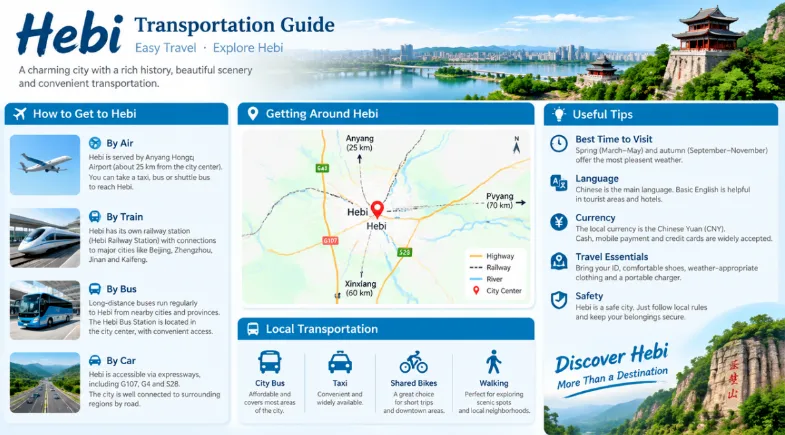
How to Get to Hebi
- High‑speed train (most recommended) : From Zhengzhou East Station, take a high‑speed train to Hebi East Station (about 30 minutes, fare about 50–60 RMB). After exiting, take a bus or taxi to the city.
- Regular train: Hebi Station has regular trains connecting major cities.
- Long‑distance bus: Zhengzhou has buses to Hebi (about 2 hours).
- Self‑drive: From Zhengzhou, take the Beijing–Hong Kong–Macau Expressway to the Hebi exit – about 1.5 hours.
Getting around Hebi
- Taxi: Starting fare 6–7 RMB; Didi Chuxing available.
- Bus: Fare 1 RMB – covers major areas.
- To attractions: Dvcau osu from Hebi city to Qi County and Xun County. For Yunmeng Mountain, Dapi Mountain, and Wuyan Mountain, it is recommended to hire a car or take a taxi.

Accommodation Recommendations
- Hebi city (Qibin District) : Many choices. Recommended: Hebi Guesthouse, Quanji Hotel, Home Inn Business – prices 200–400 RMB.
- Qi County: Near Yunmeng Mountain and Zhaoge Ruins – mid‑range hotels and guesthouses – prices 150–300 RMB.
- Xun County: Near Dapi Mountain and the ancient city – budget hotels – prices 150–250 RMB.
Booking tip: Use Booking.com, Agoda, or Trip.com. Check the “foreigners accepted” filter.

Practical Travel Tips
Language & Communication
- Major attractions have English signs, but most local restaurants and taxi drivers speak only Chinese. Download a translation app and save the offline pack.
Payment & Money
- WeChat Pay and Alipay are widely accepted. Link an international credit card in advance. Carry a small amount of cash for street vendors.
Internet & SIM Cards
- You can buy a short‑term SIM card (7–30 days) at Zhengzhou Airport or in Hebi city using your passport.
Clothing & Gear
- Yunmeng Mountain, Dapi Mountain, and Wuyan Mountain require hiking – wear non‑slip sports shoes.
- Summer: bring a sun hat and water. Winter: wear a warm coat.
- If attending the Xun County Temple Fair, wear comfortable shoes – it is very crowded.
Safety & Health
- Hebi has good public security, and attractions are well managed.
- It is recommended to purchase travel insurance.

Frequently Asked Questions about Hebi Attractions
Q: How many days do I need for Hebi?
A: At least 2 days to cover Yunmeng Mountain, Dapi Mountain, and Xun County Ancient City. If you want to visit the Qi River, Wuyan Mountain, and the Temple of Bi Gan, we recommend 3 days.
Q: What is the connection between Hebi and Investiture of the Gods?
A: Qi County in Hebi is the site of Zhaoge, the Shang dynasty capital. Many events in Investiture of the Gods took place here – characters such as King Zhou, Daji, and Jiang Ziya are all associated with Zhaoge.
Q: Is Yunmeng Mountain suitable for children?
A: Yes. There is a cable car up the mountain, and the trails are relatively gentle. Children will enjoy the Water Curtain Cave and the stories of Sun Bin and Pang Juan.
Q: Are there English‑speaking guides in Hebi?
A: Yunmeng Mountain and Dapi Mountain can arrange English guides in advance – check with Trip.com or local travel agencies.
Q: When is the Xun County Ancient Temple Fair held?
A: The Xun County Temple Fair is held every year from the first day of the first lunar month to the second day of the second lunar month. It is one of the largest temple fairs in northern China.
Hebi is an underrated historical and cultural city. Here, you can step into the legends of Investiture of the Gods, visit the ancient military academy where Guiguzi taught Sun Bin and Pang Juan, admire the solemn Northern Wei Giant Buddha, walk along the Ming dynasty city wall, and feel the poetic atmosphere of the Classic of Poetry by the Qi River. Hebi does not have the noise of a big city, but it has a historical depth accumulated over three thousand years. Whether you are a history buff, a mythology lover, or a traveler wanting to experience authentic Central Plains life, Hebi will offer you a unique and profound travel experience.
Plan your journey to Hebi – and discover the hidden charm of this birthplace of Investiture of the Gods culture!
Related Reading:
- Hebi Food Guide 2026: Must‑Try Northern Henan Flavors for Foreign Visitors
- Hebi Travel Guide 2026: Yunmeng Mountain, Ancient Chaoge & Itinerary
- Xuchang Travel Guide 2026: A Three Kingdoms Cultural Journey for Foreign Visitors
- Anyang Travel Guide 2026: Yinxu, Oracle Bones, Red Flag Canal & Itinerary
- Pingdingshan Travel Guide 2026: Yaoshan Mountain, Giant Buddha & Itinerary
- Yuntai Mountain Guide 2026: Red Stone Gorge, Waterfall & Itinerary
- Jiaozuo Travel Guide 2026: Yuntai Mountain, Tai Chi Village & Itinerary
- Luoyang Travel Guide 2026: Top Attractions, Food & Tips for Foreigners