
Anyang Attractions: Top 5 Must-Visit Places & Travel Guide 2026
Anyang, a city in the northernmost part of Henan Province, is one of China’s eight great ancient capitals. It is the birthplace of Oracle Bone Script and the source of the I Ching (Book of Changes). Here you will find the magnificent ruins of the late‑Shang‑dynasty capital from over 3,300 years ago, as well as the man‑made “sky river” carved in the 1960s. Anyang’s unique historical depth and spiritual strength attract travelers who want to explore the origins of Chinese writing and touch the pulse of early civilization. For foreign visitors, Anyang offers a cultural journey through time. This guide recommends the best attractions in Anyang and provides detailed practical information.
Anyang Attractions Overview
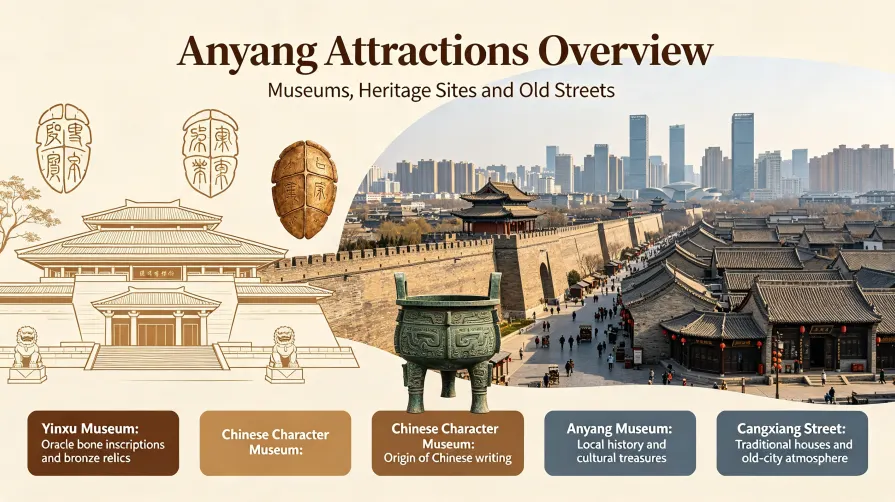
Anyang’s tourism resources can be summarized as “one site (Yinxu), one canal (Red Flag Canal), one museum (National Museum of Chinese Writing), and one temple (Yue Fei Temple).” Yinxu is the absolute core – it is the first historically documented and archaeologically confirmed capital of the late‑Shang dynasty. The Oracle Bone Script unearthed there pushed China’s recorded history back by about 1,000 years. The Red Flag Canal is a miracle of human engineering, demonstrating the great spirit of the Chinese people in transforming nature. The National Museum of Chinese Writing is the world’s only national‑level museum dedicated to writing. Yue Fei Temple honors the national hero Yue Fei. Depending on your time and interests, you can choose 2–4 of these to combine.
Detailed Introduction to Must‑See Attractions
Yinxu – The Treasure House of Oracle Bones and Shang Civilization
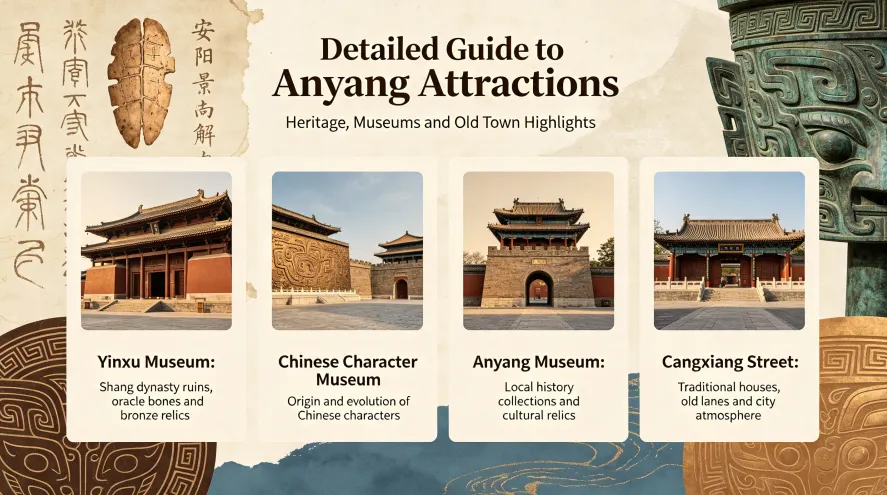
Yinxu is the site of the late‑Shang‑dynasty capital (approximately 1300–1046 BC), located on the northwestern outskirts of Anyang, spanning both banks of the Huan River. It is the first historically documented and archaeologically confirmed capital in China and a UNESCO World Heritage site. The discovery of Yinxu not only confirmed the existence of the Shang dynasty but also pushed China’s documented history back by about 1,000 years – it is a sacred site of Chinese archaeology.
Core highlights:
- The discovery site of Oracle Bones: This is the most significant aspect of Yinxu. In 1899, the epigrapher Wang Yirong noticed carved symbols on “dragon bones” (traditional medicinal fossils), and later research confirmed these were Shang‑dynasty writings. To date, about 150,000 oracle bone fragments have been unearthed, with roughly 4,500 distinct characters, of which about 1,500 have been deciphered. This is the earliest mature writing system in China, marking the beginning of recorded history. In the exhibition halls, you can see these ancient characters carved on turtle shells and animal bones, feeling how people recorded their lives over 3,000 years ago.
- Tomb of Lady Fu Hao: One of the most stunning archaeological finds at Yinxu. Lady Fu Hao was a wife of King Wu Ding of Shang and the first historically documented female general in China. Her tomb is the only intact Shang royal burial discovered at Yinxu, yielding 1,928 artifacts, including bronzes, jades, and bone objects. The Fu Hao Owl Zun (a bronze wine vessel shaped like an owl) is a national treasure. Standing before the restored display, you can imagine this legendary woman – commanding armies on the battlefield while enjoying royal honor at court.
- Palace and Temple Foundations: These show the grand layout of Shang‑dynasty palace architecture. Dozens of building foundations are scattered across the site, reflecting the city planning of the late‑Shang capital. Visitors can see reconstructed palace structures, sacrificial pits, and chariot pits. The three groups of foundations – Jia, Yi, and Bing – each served different purposes: some for state affairs, some for sacrifices, and some for residence. Through these remains, you can glimpse the political and religious life of the Shang kingdom over 3,000 years ago.
- Royal Cemetery: Located on the north bank of the Huan River, this is the burial area for the Shang royal family. There are 13 large tombs – although most have been looted over the centuries, the site itself is historically significant. You can visit excavated areas and see on‑site displays of unearthed artifacts. One of the large tombs has a passageway tens of meters long, reflecting the grand scale of Shang royal burials.
- Yinxu Museum (New Hall): Opened in 2024, this is currently the largest Shang‑theme museum in China. It houses a rich collection of bronzes, oracle bones, jades, and pottery from Yinxu. The modern architectural design creates a striking contrast with the ancient ruins. The new museum features more modern displays and interactive experiences, helping you better understand Shang civilization.
Practical information:
- Ticket: 70 RMB (includes Palace and Temple area and Royal Cemetery)
- Yinxu Museum (New Hall): Free, but a reservation is required on the official WeChat account
- Opening hours: 8:00 – 17:30 (closes at 17:00 in winter)
- Recommended visit duration: Half a day to a full day (3–5 hours)
Why you must go: Yinxu is a sacred site of Chinese archaeology, the birthplace of oracle bone script, and an essential stop for understanding early Chinese civilization. For anyone interested in history, its value is unparalleled.
Red Flag Canal – The Miracle of a Man‑Made Sky River
The Red Flag Canal is located in Linzhou City (formerly Linxian County), Anyang. It is a man‑made canal carved into the cliffs of the Taihang Mountains over a period of ten years (1960–1969) under extremely difficult conditions. The total length is about 1,500 km (930 miles). It is known as the “Eighth Wonder of the World” and the “Artificial Sky River.” It is not just a water conservancy project but also a symbol of the Chinese people’s spirit of self‑reliance and hard work.
Core highlights:
- Youth Cave (Qingnian Dong): One of the most famous spots on the canal. This is the key passage of the canal, dug by 300 young volunteers on the cliff face – hence the name. The cave is 623 meters long and symbolizes the spirit of the Red Flag Canal. You can take a boat ride through the cave to experience the difficulty of its construction. As the boat moves, the rock walls are within reach, and dripping water echoes overhead – as if you can still hear the clang of steel drills and hammers from that era.
- Water Diversion Sluice: The main canal splits into three branches here, irrigating over 50,000 acres of farmland in Linzhou. This is the key site for understanding the overall design of the canal system. Standing at the sluice, you can see how the water is precisely distributed in different directions, reflecting the engineering’s ingenious design.
- Red Flag Canal Memorial Hall: Displays the historical background, engineering challenges, and heroic stories of the canal builders. Extensive photographs, artifacts, and videos give visitors a deep appreciation of the perseverance and ingenuity of the local people. The hall displays tools such as steel drills, hammers, and ropes used during the construction, as well as photos and mementos of the heroes who emerged during the process. Visiting the memorial hall provides a comprehensive understanding of the canal’s historical significance.
- One‑Line Sky (Yixiantian) and Luosi Pool: Natural scenic spots along the canal. One‑Line Sky is a narrow rock crevice only wide enough for one person to pass through – walking through it feels like being inside a crack in the earth. Luosi Pool is a deep pool on the Zhuozhang River, with green water and cliffs on both sides – a deep and secluded scene. These natural landscapes complement the man‑made canal, forming a unique panorama.
- Taihang Mountain Scenery: The canal is set against the magnificent backdrop of the Taihang Mountains. Especially in autumn, red leaves and the winding canal create a beautiful picture – a great season for photography.
Practical information:
- Ticket: 80 RMB (includes Memorial Hall and Youth Cave)
- Sightseeing bus: One way 12 RMB, round trip 24 RMB
- Boat ride: Youth Cave boat tour 30 RMB
- Opening hours: 8:00 – 18:00
- Recommended visit duration: Half a day to a full day
Why you must go: The Red Flag Canal is a miracle in human engineering history and a symbol of the Chinese people’s hard work and determination. Whether you are an engineering enthusiast, a history researcher, or simply an admirer of natural beauty, the Red Flag Canal will leave you inspired and moved.
National Museum of Chinese Writing – The Encyclopedia of Chinese Characters
Located in downtown Anyang, this is the world’s only national‑level museum dedicated to writing. It not only presents the origin, development, and evolution of Chinese characters but also introduces other major writing systems from around the world. The museum’s golden, magnificent modern architecture symbolizes how Chinese characters are the golden treasure of Chinese culture.
Core highlights:
- Permanent exhibition: “The History of Chinese Writing” takes you through the evolution from oracle bone script, bronze inscription, seal script, clerical script, to standard script (kaishu). You can see real oracle bone fragments from the Shang and Zhou dynasties and learn how Chinese characters developed from pictorial symbols to the square characters used today. The exhibition also features many fine calligraphy works from various dynasties, showcasing the artistic beauty of Chinese writing.
- Interactive zone: You can use an electronic pen to trace oracle bone characters and experience ancient writing. This is the most intuitive way to appreciate the beauty of Chinese characters. You can write with your finger on a touchscreen – the system provides scores and feedback – it is a lot of fun.
- Ethnic minority scripts: The museum also displays scripts of China’s ethnic minorities – such as Tibetan, Mongolian, and Uyghur – enriching visitors’ understanding of the diversity of human writing. Here you can see the writing styles and characteristics of different ethnic scripts and appreciate the cultural diversity of China as a multi‑ethnic nation.
Practical information:
- Ticket: Free, but a reservation is required on the official WeChat account
- Opening hours: 9:00 – 17:00 (closed on Mondays)
- Recommended visit duration: 2–3 hours
Why you must go: For foreign visitors interested in language and writing, this museum is an excellent place to understand Chinese character culture. Even if you do not speak Chinese, you can appreciate the beauty and logic of the characters through visual displays and interactive exhibits.
Yue Fei Temple – Memorial to a National Hero
Yue Fei Temple is located in Tangyin County, Anyang. It commemorates Yue Fei, a famous general of the Southern Song dynasty who fought against the Jin invasion. Yue Fei is one of the most revered national heroes in Chinese history, and his spirit of “loyalty to the country” has had a lasting impact. Tangyin is Yue Fei’s hometown, and the temple here was first built in the Ming dynasty, undergoing many renovations, preserving a large number of precious historical relics.
Core highlights:
- Shi Quan Shrine: Dedicated to Shi Quan, a patriot who attempted to assassinate the traitor Qin Hui – reflecting the people’s support for Yue Fei. Inside, there is a vivid statue of Shi Quan holding a sword aimed at Qin Hui.
- Yue Fei statue: A seated statue in the main hall – solemn and dignified. Above the statue hangs a plaque inscribed with “Return Our Rivers and Mountains,” expressing Yue Fei’s ambition to recover lost territory.
- Stele inscriptions: The temple preserves many inscriptions from famous figures throughout history, including a calligraphy piece by Emperor Qianlong of the Qing dynasty. These steles are not only treasures of calligraphy but also record the admiration for Yue Fei across generations.
- Yue Fei’s life exhibition: Through pictures, artifacts, and scene reconstructions, it systematically presents Yue Fei’s legendary life from an ordinary soldier to a celebrated general.
Practical information:
- Ticket: 50 RMB
- Opening hours: 8:00 – 17:30
- Recommended visit duration: 1.5–2 hours
Why you must go: To understand Chinese history and culture, Yue Fei is an unavoidable figure. Yue Fei Temple is an important place to experience the values of loyalty and righteousness in Chinese culture.
Yuan Lin – Yuan Shikai’s Mausoleum
Yuan Lin is the mausoleum of Yuan Shikai, the first President of the Republic of China, located in Beiguan District, Anyang. It was built between 1916 and 1918. The architectural style is unique, blending traditional Chinese mausoleum design with Western elements – an important witness to modern Chinese history.
Core highlights:
- Stone statues: Along the spirit path, there are stone lions, horses, and tigers – with a distinctive Sino‑Western style. The statues combine the solemnity of traditional Chinese stone carving with the influence of Western realism.
- Stele pavilion: Houses a stele recording Yuan Shikai’s life – the architecture is solemn and distinctive. The roof uses traditional Chinese hip‑and‑gable style, while the columns and decorations incorporate Western elements.
- Tomb mound: A large earthen mound surrounded by blue stone railings and a Western‑style archway. The overall style presents a unique Sino‑Western fusion, making it stand out among Chinese mausoleum architecture.
Practical information:
- Ticket: 35 RMB
- Opening hours: 8:00 – 17:30
- Recommended visit duration: 1–1.5 hours
Suggested Itineraries for Anyang
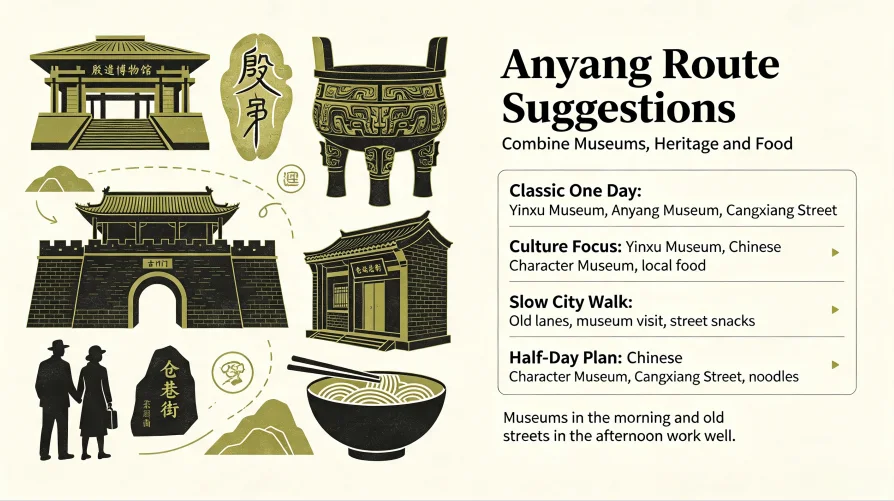
2‑Day Classic Tour (Yinxu + Writing Museum + Yuan Lin)
- Day 1: Morning – visit Yinxu Palace and Temple area and Royal Cemetery (about 3–4 hours). Afternoon – visit Yinxu Museum (New Hall, about 2 hours). Overnight in Anyang city.
- Day 2: Morning – visit the National Museum of Chinese Writing (about 2.5 hours). Afternoon – visit Yuan Lin (about 1.5 hours). Return in the evening.
3‑Day In‑Depth Tour (Add the Red Flag Canal)
- On the basis of the 2‑day tour, add a third day to visit the Red Flag Canal in Linzhou (needs a full day). The drive from Anyang to the Red Flag Canal takes about 1.5 hours – it is recommended to hire a car or join a tour.
4‑Day Panorama Tour (Add Yue Fei Temple)
- On the basis of the 3‑day tour, add a fourth day: morning – visit Yue Fei Temple in Tangyin County (about 2 hours). Return in the afternoon or continue to a neighboring city.
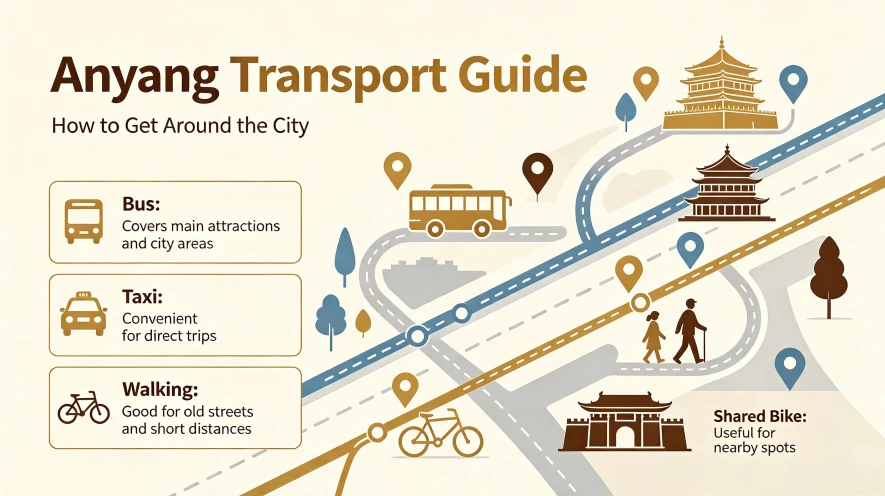
Transportation Guide for Anyang
How to Get to Anyang
- High‑speed train (most recommended): From Zhengzhou East Station, take a high‑speed train to Anyang East Station (about 50 minutes to 1 hour, fare about 80–100 RMB). After exiting, take a bus or taxi to the city.
- Regular train: Anyang Station has regular trains connecting major cities – suitable for budget travelers.
- Long‑distance bus: Zhengzhou has buses to Anyang (about 2.5 hours).
- Self‑drive: From Zhengzhou, take the Beijing–Hong Kong–Macau Expressway to the Anyang exit – about 2 hours.
Local transportation
- Anyang city: Taxi starting fare 7–8 RMB; Didi Chuxing available. Bus fare 1 RMB.
- To Yinxu: About 10 minutes by taxi from downtown, or take bus 1 or 18.
- To the National Museum of Chinese Writing: About 15 minutes by taxi, or take a tourist bus.
- To Yuan Lin: About 10 minutes by taxi.
- To Red Flag Canal: Take a bus from Anyang Bus Station in the direction of Linzhou, get off at the Red Flag Canal scenic area – about 1.5 hours. It is recommended to hire a private car or join a day tour.
Accommodation Recommendations
- Anyang city (Wenfeng District, Beiguan District): Many choices, convenient transport. Recommended hotels: Wanda Realm, Quanji Hotel, Home Inn Business – prices 200–500 RMB.
- Linzhou (near Red Flag Canal): Red Flag Canal Guesthouse, Taihang Mountain guesthouses – prices 200–400 RMB.
Booking tip: Use Booking.com, Agoda, or Trip.com. Check the “foreigners accepted” filter.
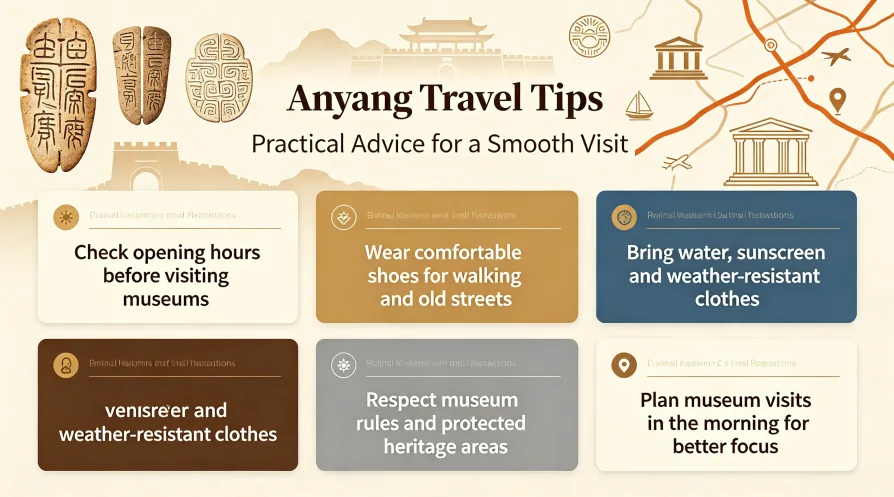
Practical Travel Tips for Anyang
Language & Communication
Major attractions have English signs, but most local restaurants and taxi drivers speak only Chinese. Download a translation app and save the offline pack.
Payment & Money
WeChat Pay and Alipay are widely accepted. Link an international credit card in advance. Carry a small amount of cash (200–300 RMB) for street vendors and emergencies.
Internet & SIM Cards
You can buy a short‑term SIM card (7–30 days) at Zhengzhou Airport or in Anyang city using your passport.
Clothing & Gear
- Yinxu and the museums are mostly indoors – wear comfortable clothes.
- The Red Flag Canal has mountain paths and steps – wear non‑slip sports shoes.
- Summer: bring a sun hat and water. Winter: wear a down jacket.
Safety & Health
- Anyang has good public security, and attractions are well managed.
- Some sections of the Red Flag Canal are near cliffs – follow the signs and do not climb over railings.
- It is recommended to purchase travel insurance.
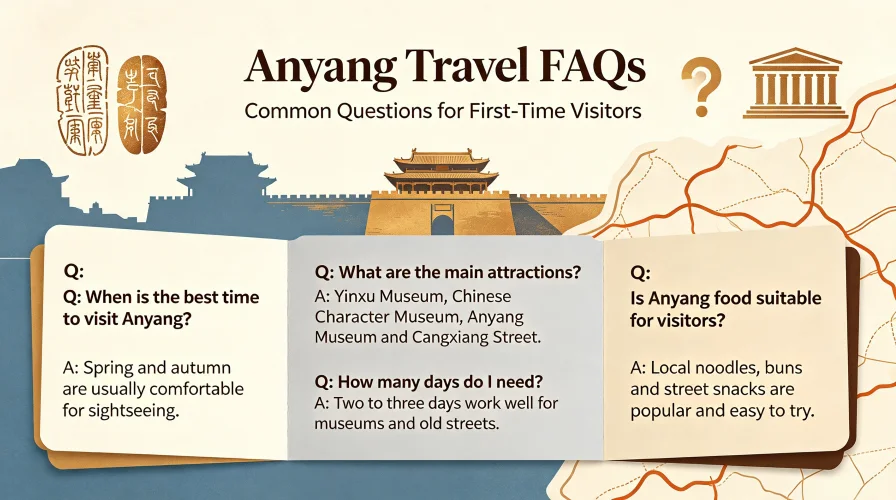
Frequently Asked Questions about Anyang Attractions
Q: Do I need to book in advance for Yinxu and the Writing Museum?
A: The Yinxu Museum (New Hall) and the National Museum of Chinese Writing are free but require reservation on their official WeChat accounts. Yinxu ruins tickets can be bought on site or online.
Q: How many days do I need for Anyang?
A: At least 2 days to cover Yinxu and the Writing Museum. If you want to visit the Red Flag Canal, add 1 more day.
Q: How far is the Red Flag Canal from Anyang city?
A: About 60 km (37 miles) – a 1.5‑hour drive. It is recommended to hire a car or join a day tour.
Q: Are there English‑speaking guides in Anyang?
A: Yinxu and the Red Flag Canal can arrange English guides in advance – check with Trip.com or local travel agencies.
Q: Are Anyang’s attractions suitable for children?
A: Yinxu and the Writing Museum have rich interactive experiences, suitable for children. The hiking trails at the Red Flag Canal are somewhat challenging for children, but you can choose boat rides and sightseeing buses.
Anyang is a city that holds the memory of China’s early civilization. Here, you can touch the 3,300‑year‑old oracle bones, feel the long history of Chinese writing, stand on the cliff‑side paths of the Red Flag Canal and marvel at the resilience of human will, or visit Yue Fei Temple to hear the story of a national hero. Unlike Xi’an or Luoyang, which are crowded with tourists, Anyang awaits true history enthusiasts with its calm, deep character.
Plan your journey to Anyang – and discover the land that holds China’s earliest written records and stories.
Related Reading:
- Anyang Food Guide 2026: Daokou Chicken, Bianfen Noodles & Local Delicacies
- Anyang Travel Guide 2026: Yinxu, Oracle Bones, Red Flag Canal & Itinerary
- Pingdingshan Attractions: Top 5 Must-Visit Places & Travel Guide 2026
- Henan Travel Guide 2026: Itinerary, Attractions & Tips for Foreigners
- What is the Specialty of Henan Food? A Foreigner’s Guide to Henan Cuisine
- Zhengzhou Food Guide: Must-Try Dishes Like HuiMian & HuLaTang (2026)