

Dengfeng Travel Guide 2026: Shaolin Temple, Mount Song & Itinerary
Dengfeng travel guide
Dengfeng, a city in central Henan Province, is known worldwide for the Shaolin Temple and Mount Song (Songshan). It is the birthplace of Chan (Zen) Buddhism and the cradle of Chinese kung fu. In 2010, the “Historic Monuments of Dengfeng in the ‘Center of Heaven and Earth’” were inscribed as a UNESCO World Heritage Site, including 11 ancient architectural complexes such as the Shaolin Temple, the Pagoda Forest, the Songyang Academy, and the Zhongyue Temple. For foreign travelers, Dengfeng is not only a pilgrimage for martial arts but also an excellent opportunity to experience traditional Chinese culture and natural beauty. This guide provides complete information on transportation, attractions, itineraries, food, and accommodation to help you plan your Dengfeng trip easily.
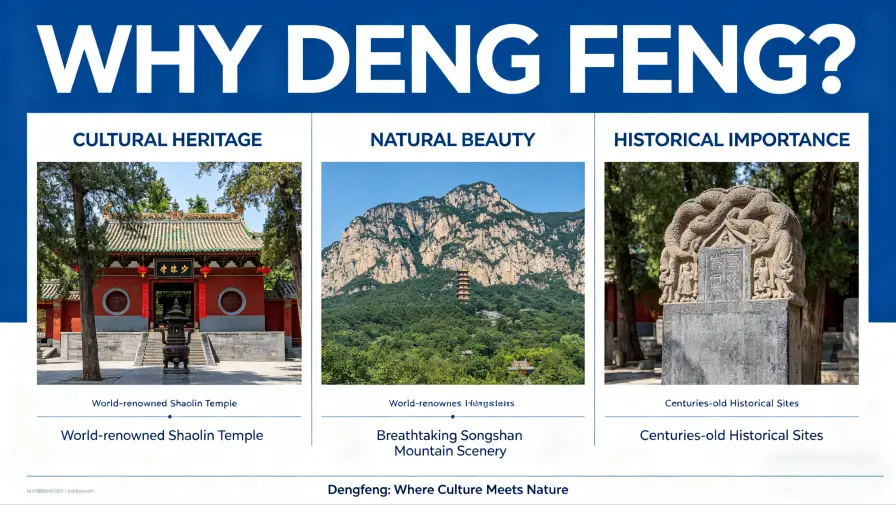
Why Choose Dengfeng?
The main attractions of Dengfeng are the Shaolin Temple and Mount Song. The Shaolin Temple is the spiritual home of martial arts lovers worldwide. You can watch a thrilling kung fu performance, visit the thousand‑year‑old temple, and see the ancient pagodas of past monks. Mount Song is one of China’s Five Great Mountains, known as the “Central Mountain.” Its Sanhuang Village area features a cliff‑side plank road and amazing rock formations. In addition, the Songyang Academy is one of China’s four great ancient academies, and the Zhongyue Temple is the largest ancient architectural complex among the Five Great Mountains. Dengfeng is only a 1.5‑hour drive from Zhengzhou, making it suitable for a day trip or a two‑day in‑depth visit.
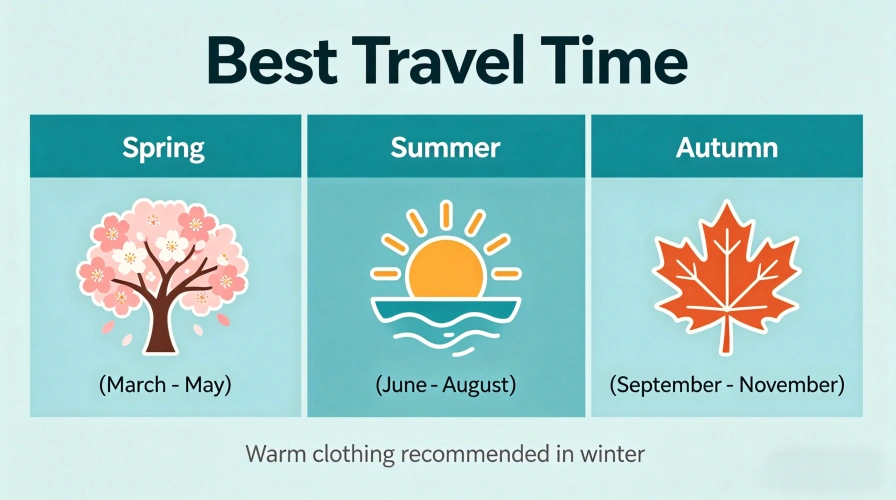
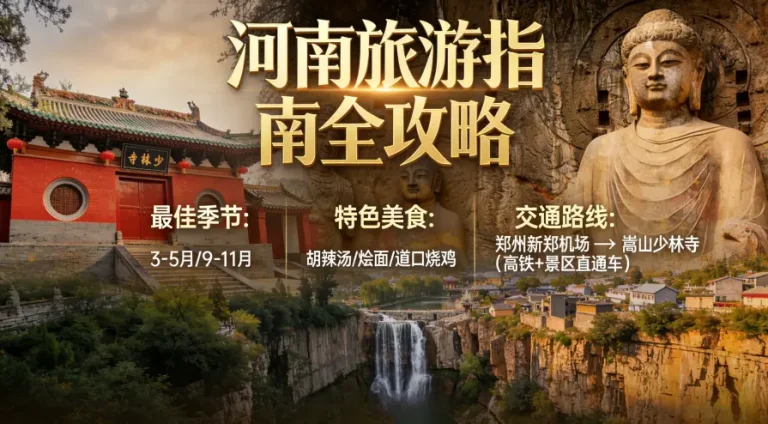
Best Time to Visit
- Best seasons: Spring (April–May) and Autumn (September–October). Temperatures range from 15–25°C (59–77°F). The mountain air is fresh, great for hiking and outdoor activities. In autumn, the red leaves on Mount Song are spectacular.
- Summer (June–August): Cooler in the mountains, but afternoon showers are common. Shaolin Temple gets crowded – go early.
- Winter (December–February): Cold and dry, with occasional snow. Few tourists – you can enjoy a quiet temple atmosphere, but some cable cars may be closed.
- Avoid: Chinese public holidays (National Day Golden Week, Oct 1–7, May Day). The Shaolin Temple becomes extremely crowded, and waiting times and the overall experience will be much worse.
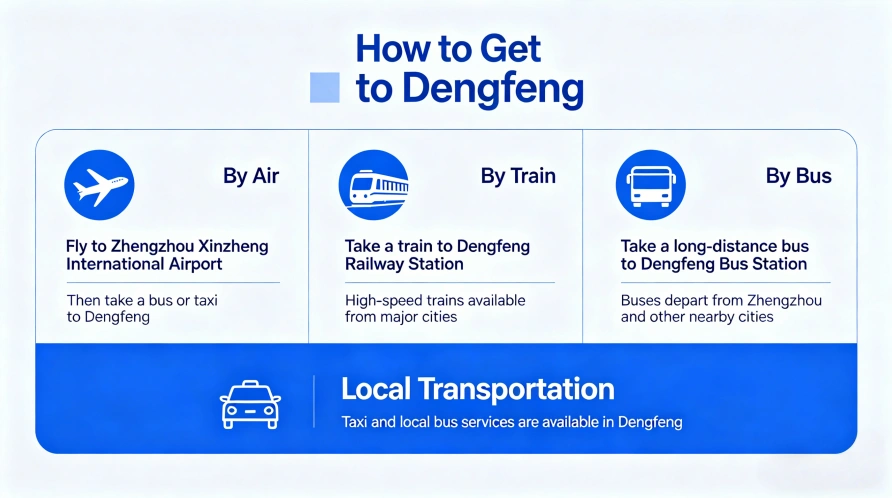
How to Get to Dengfeng
From Zhengzhou
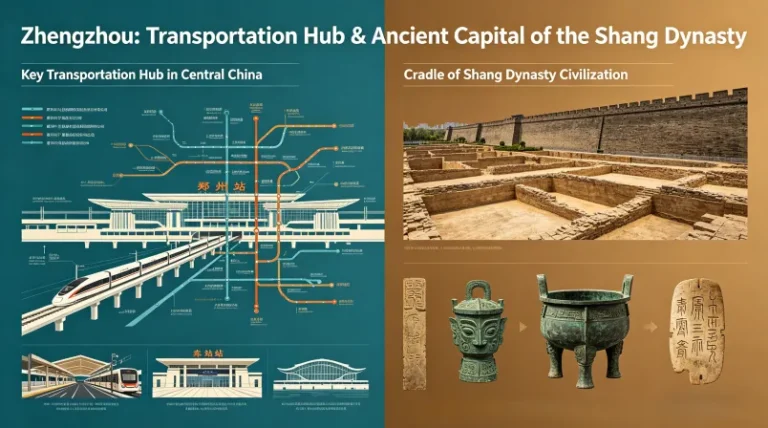
Dengfeng does not have a high‑speed rail station. The most common ways are taking a long‑distance bus or a private car from Zhengzhou.
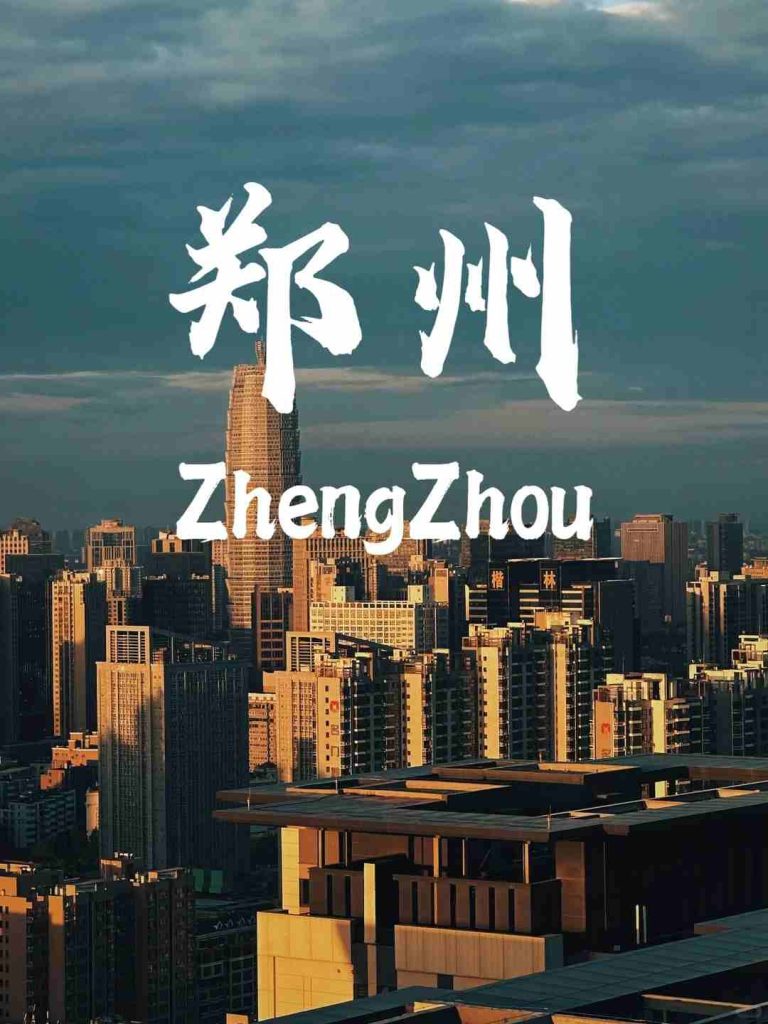
- Tourist bus (most economical): Take a bus from Zhengzhou Central Bus Station (east square of Zhengzhou Railway Station) to Dengfeng. The ride takes about 1.5–2 hours, and the ticket costs about 25–35 RMB. Buses run frequently from 7 AM to 5 PM. After arriving at Dengfeng Bus Station, take a local bus or taxi to Shaolin Temple (about 15 minutes).
- Private car / ride‑hailing (most flexible): Use the Didi Chuxing International app. A one‑way trip from your Zhengzhou hotel directly to Shaolin Temple takes about 1.5 hours and costs about 150–200 RMB. A full‑day car rental (8 hours) costs about 400–600 RMB – good for small groups.
- Join a day tour (most hassle‑free): Book a “Shaolin Temple Day Tour from Zhengzhou” on Viator, GetYourGuide, or Trip.com. Tours include hotel pickup, tickets, lunch, and an English‑speaking guide. Price: about 300–500 RMB per person.
From Luoyang
If you are in Luoyang, it is also convenient to go to Dengfeng. Luoyang Bus Station has buses to Dengfeng – the ride takes about 1.5 hours. Or hire a private car – one way takes about 1 hour.
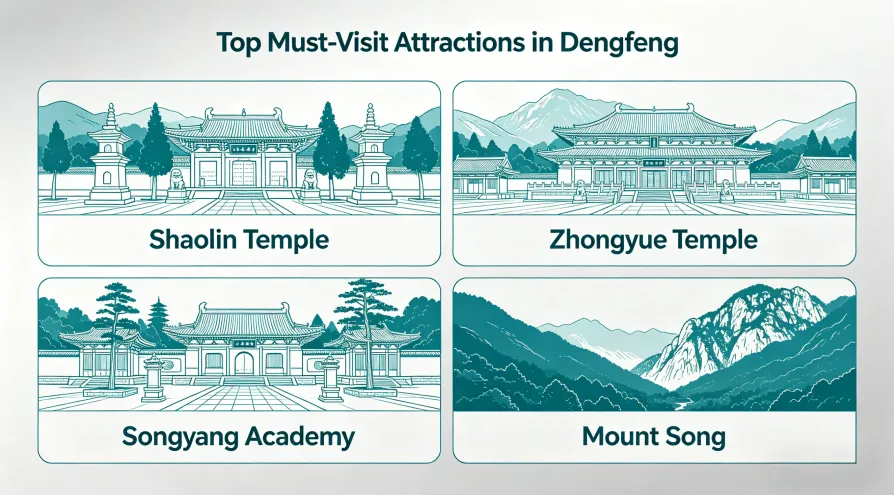
Must‑See Attractions in Dengfeng
Shaolin Temple – The Sacred Site of Kung Fu and Chan Buddhism
Shaolin Temple was first built in 495 AD during the Northern Wei dynasty, established by Emperor Xiaowen for the Indian monk Batuo. In the Tang dynasty, thirteen Shaolin kung fu monks saved the future emperor Li Shimin, and Shaolin kung fu became famous across China. Today, the Shaolin Temple is a large scenic area. The main highlights include:
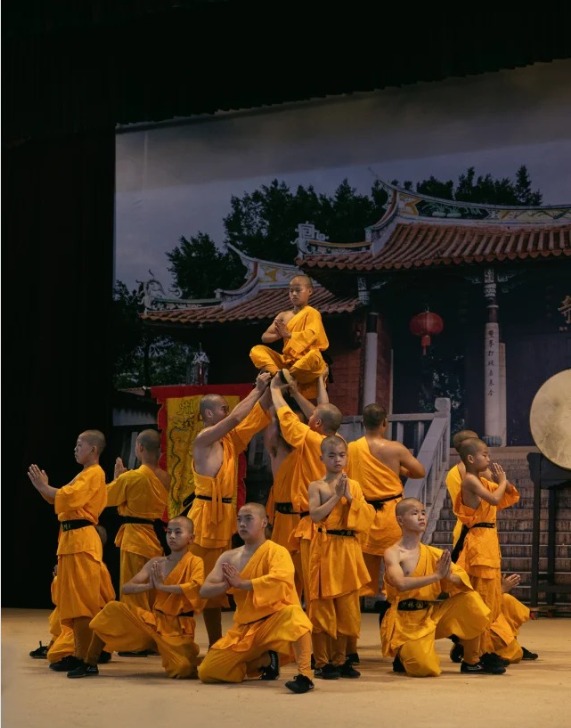
- Kung Fu Performance: Takes place in the Wushu Hall inside the scenic area. There are multiple shows every day (usually once per hour). Each performance lasts about 30 minutes, demonstrating bare‑handed forms, weapons, and hard qigong. It is recommended to watch the performance before touring the temple. Show times change with seasons – check immediately after arrival.
- Changzhuyuan (Main Temple): The main architectural complex of Shaolin Temple, including the Mountain Gate (with a plaque written by Emperor Kangxi of the Qing dynasty), Heavenly King Hall, Grand Hall, Lixue Pavilion (which tells the story of Huike cutting off his arm to receive Dharma transmission), and Thousand Buddha Hall (where there are foot pits left by monks practicing kung fu over generations).
- Pagoda Forest: Located west of the temple. This is the largest existing ancient pagoda complex in China, with more than 200 brick and stone pagodas from the Tang, Song, Jin, Yuan, Ming, and Qing dynasties – the final resting place of past eminent monks. The shape and height of a pagoda represent the monk’s status. Do not climb or sit on the pagodas.
- Chuzu Temple (First Ancestor’s Hall): Built to commemorate Bodhidharma. Inside, there is a Song dynasty hall and murals.
- Bodhidharma Cave: Located on Wuru Peak. Legend says Bodhidharma meditated facing a wall here for nine years. It takes about 30 minutes to climb up.
Practical information:
- Ticket: 80 RMB (includes Changzhuyuan, Pagoda Forest, and Chuzu Temple). The Shaolin Cableway or Songyang Cableway requires separate tickets.
- Opening hours: Approximately 7:30 – 18:00 (varies by season).
- Visit duration: At least 3–4 hours (excluding mountain climbing).
- Guide: You can rent an English audio guide (30 RMB) at the entrance, or book an English‑speaking guide in advance.
Mount Song – The Grand Scenery of the Central Mountain
Mount Song is divided into two parts: Shaoshi Mountain and Taishi Mountain. The Shaolin Temple is at the foot of Shaoshi Mountain. The area most tourists visit is the Sanhuang Village scenic area on Shaoshi Mountain.
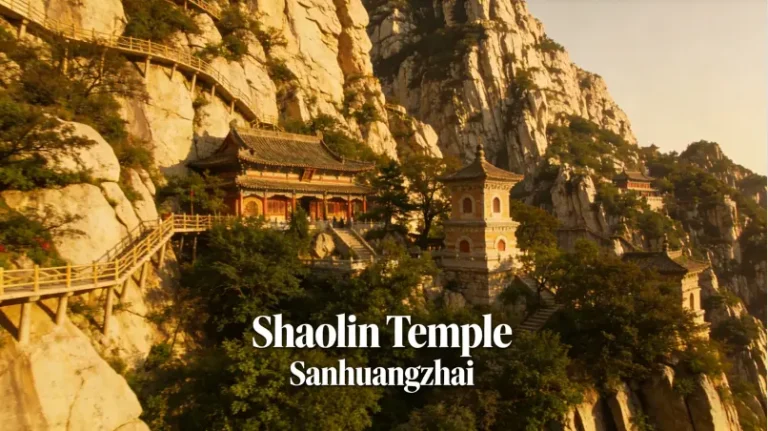
- Sanhuang Village: Famous for its奇特 granite peaks and a plank road built on cliffs. Take the Shaolin Cableway (round trip about 100 RMB) up the mountain, then hike the plank road for about 1.5–2 hours to reach Sanhuang Village Temple. Along the way, you will see the “Book Cliff” – layers of rock standing up like a giant book – a very spectacular sight. If you have good energy, you can go further, but watch your time.
- Taishi Mountain: Includes Junji Peak, Songyang Academy, Zhongyue Temple, etc. If you have limited time, prioritize Shaoshi Mountain.
Practical information: Cableway operating hours are about 8:00 – 17:00. Wear non‑slip sports shoes and bring enough water.
Songyang Academy – Ancient Academic Hall
Songyang Academy is one of the four great ancient academies of China. It was first built in the Northern Wei dynasty. In the Song dynasty, the brothers Cheng Hao and Cheng Yi lectured here, which had a deep influence on the development of Confucian Neo‑Confucianism. Inside the academy are two ancient cypress trees, said to have been named “General Cypress” by Emperor Wu of Han. The architecture is simple, and the environment is quiet.
- Ticket: 30 RMB.
- Visit duration: About 1 hour.
- Location: North of Dengfeng city. Take a taxi from Shaolin Temple (about 20 minutes).
Zhongyue Temple – Largest Ancient Building Complex Among the Five Mountains
Zhongyue Temple was a place for offering sacrifices to the god of Mount Song. It was first built in the Qin dynasty. The existing buildings were rebuilt in the Qing dynasty. The central axis buildings extend one after another, creating a magnificent atmosphere. Inside the temple are iron statues from the Song dynasty and many ancient stone steles. There are far fewer tourists here than at Shaolin Temple – you can quietly experience Taoist culture.
- Ticket: 30 RMB.
- Visit duration: About 1.5 hours.
- Location: Eastern part of Dengfeng city. Take a taxi from Songyang Academy (about 15 minutes).
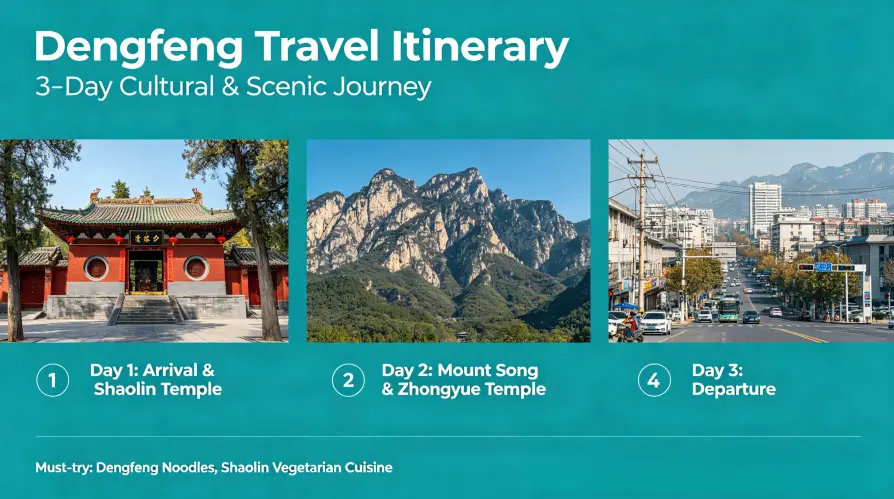
Suggested Itineraries for Dengfeng
One‑Day Trip (Compact, Best for a Round Trip from Zhengzhou)
- Morning (7:00 – 12:00): Take an early bus or private car from Zhengzhou to Shaolin Temple (1.5 hours). After arriving, watch the kung fu performance (choose the 9:30 or 10:30 show), then visit Changzhuyuan and the Pagoda Forest. If time permits, take the Shaolin Cableway up to Sanhuang Village, walk a short section of the plank road, then come back down.
- Lunch (12:00 – 13:00): Have lunch outside the Shaolin Temple scenic area or in Dengfeng city. Try Shaolin vegetarian food or local Henan dishes.
- Afternoon (13:30 – 16:30): Go to Songyang Academy (about 40 minutes) and Zhongyue Temple (about 1.5 hours) – choose one of them. If you are interested in Confucian culture and Taoist architecture, Zhongyue Temple is more unique.
- Late afternoon (16:30 – 18:00): Take a bus or private car back to Zhengzhou.
Note: A one‑day trip is quite tight. It is recommended to skip the Sanhuang Village hike and focus on Shaolin Temple plus one other attraction. Alternatively, only visit Shaolin Temple + the cableway (without hiking deep into the mountain) and skip Songyang Academy and Zhongyue Temple.
Two‑Day Trip (In‑Depth Experience) – Recommended for travelers who truly want to feel Mount Song
- Day 1: Depart from Zhengzhou in the morning, arrive in Dengfeng before noon. Afternoon: Visit Shaolin Temple (kung fu performance + Changzhuyuan + Pagoda Forest). Then take the Shaolin Cableway up to Sanhuang Village, hike the plank road to the suspension bridge or Sanhuang Village Temple, then take the cableway back down in the late afternoon. Stay overnight in Dengfeng city. Try local specialties for dinner (e.g., Shaolin vegetarian biscuits, mustard strips).
- Day 2: Morning: Visit Songyang Academy (about 1 hour) and Zhongyue Temple (about 1.5 hours). After lunch, if you still have energy, you can climb Taishi Mountain (Junji Peak) – round trip takes about 4–5 hours. Or visit the Dengfeng Observatory (built by the Yuan dynasty astronomer Guo Shoujing, part of the World Heritage extension). In the afternoon, return to Zhengzhou or go to Luoyang.

Dengfeng Food Recommendations
Dengfeng’s food culture is influenced by the Shaolin Temple, with a noticeable vegetarian tradition, as well as authentic Henan dishes.
- Shaolin Vegetarian Biscuits: Crispy biscuits made of flour, sugar, oil, and sesame, available in sweet and salty flavors. A famous souvenir.
- Mustard Strips (Jiecai Si): A local specialty – shredded mustard root pickled until spicy and refreshing. Great as an appetizer.
- Shaolin Temple Vegetarian Feast: Vegetarian restaurants inside the scenic area offer imitation meat dishes (e.g., “vegetarian meat”, “vegetarian fish”). Tasty but a bit expensive.
- Dengfeng Shaobing (Baked Flatbread): Common in local breakfast. Crispy on the outside, often stuffed with tofu skewers or egg, and very affordable.
- Braised Noodles (Huimian): There are good noodle shops in Dengfeng city serving rich mutton broth and thick noodles.
Recommended restaurants: Several local eateries on Dongguan Street and Zhongyue Avenue in Dengfeng city.
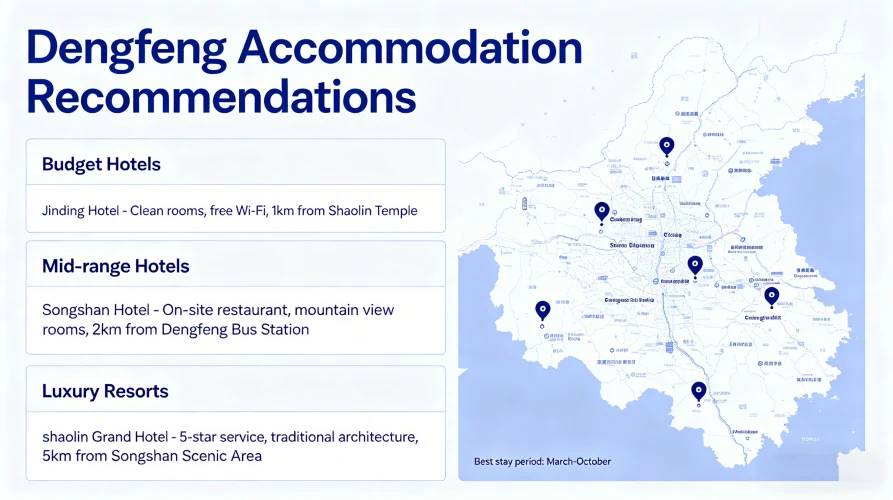
Accommodation in Dengfeng
- Near Shaolin Temple Scenic Area: Convenient for entering the temple early the next morning, but fewer choices and higher prices. Example: Shaolin Temple International Wushu Hotel (simple and clean, about 200–300 RMB).
- Dengfeng City: Many choices, good value. Recommended: Dengfeng Zhongzhou Huading Hotel (4‑star, about 300–500 RMB) or chain hotels like Jinjiang Inn, Hanting (about 150–250 RMB). More convenient for food and shopping.
- Themed guesthouses: Some meditation‑style guesthouses at the foot of Mount Song – quiet and peaceful, suitable for travelers who like calm surroundings.
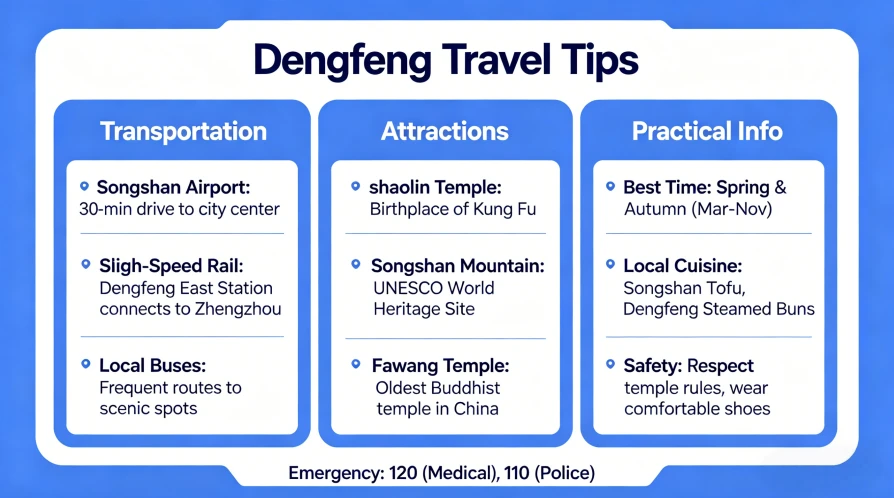
Practical Travel Tips for Dengfeng
Language & Communication
Shaolin Temple has English signs and English audio guides. Restaurants and taxi drivers in Dengfeng city generally speak only Chinese. Download Google Translate or Microsoft Translator and pre‑download the offline Chinese pack. Learn a few words: Shaolin Temple, Mount Song, ticket, and how much.
Payment & Money
WeChat Pay and Alipay are widely accepted at the Shaolin Temple and in the city. However, some small stalls in Dengfeng may prefer cash. Carry 200–300 RMB in small denominations.
Clothing & Gear
- Must wear comfortable hiking or sports shoes. The temple area has stone paths, and the Sanhuang Village plank road has many steps – sandals or leather shoes are not recommended.
- Summer: sun hat, sunglasses, insect repellent. Winter: down jacket, gloves. Spring/autumn: light jacket.
- Carry a backpack with water and snacks. Options on the mountain are limited and expensive.
Safety & Tickets
- The scenic area is crowded – keep an eye on your belongings.
- The Mount Song cableway is high – be cautious if you have a fear of heights. Follow the signs and do not climb over railings.
- Tickets can be purchased in advance on Trip.com or Meituan to avoid waiting.
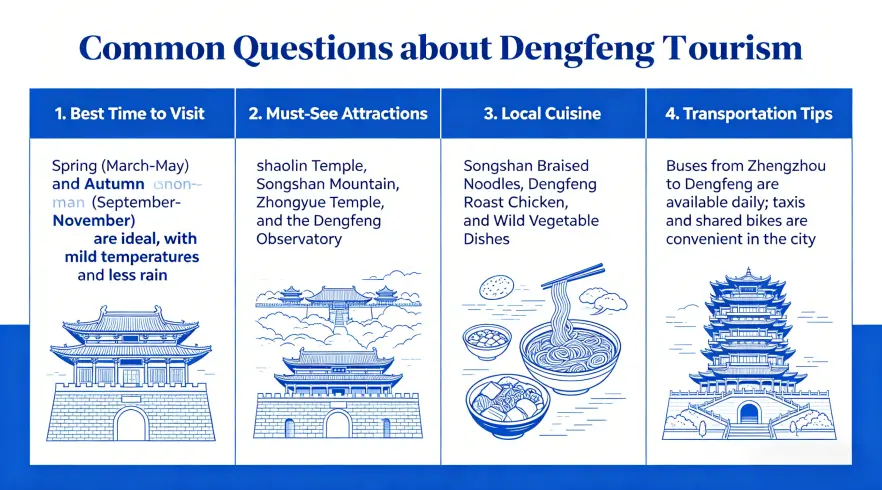
Frequently Asked Questions about Dengfeng
Q: Is one day enough for a Dengfeng trip?
A: If you only want to see the Shaolin Temple (kung fu performance + main temple + Pagoda Forest), one day is enough. If you want to hike in Sanhuang Village or visit Songyang Academy and Zhongyue Temple, plan for two days.
Q: Is the kung fu performance at Shaolin Temple worth watching?
A: Absolutely. It is the most direct display of Shaolin kung fu. The monk performers have trained since childhood – the movements are real and powerful.
Q: Does Dengfeng have a high‑speed rail station?
A: No. The nearest high‑speed rail stations are Zhengzhou East Station or Luoyang Longmen Station – you need to transfer to a bus.
Q: How difficult is the hiking at Sanhuang Village?
A: The plank road is mostly flat, but there are many steps up and down. A full round trip takes about 3–4 hours. If you have average fitness, you can take the cableway and hike only to the suspension bridge and then return.
Q: What souvenirs are worth buying in Dengfeng?
A: Shaolin vegetarian biscuits, mustard strips, Shaolin sword (craft), and Mount Song stone paintings.
Final Words
Dengfeng is a city famous for Shaolin and magnificent because of Mount Song. Whether you come for kung fu or for the zen atmosphere and natural scenery, it will meet your expectations. A one‑day trip lets you experience the essence of the Shaolin Temple. A two‑day trip allows you to deeply explore Mount Song and the ancient architectural complexes. Plan your transport and itinerary, wear comfortable shoes, bring curiosity and respect – and begin your pilgrimage to Dengfeng.
May you find inner peace at Shaolin Temple and feel the vastness of heaven and earth from the peak of Mount Song.
Related Reading:
- Zhengzhou to Kaifeng Day Trip 2026: Itinerary, Transport & Night Market Tips
- Luoyang Travel Guide 2026: Top Attractions, Food & Tips for Foreigners
- Henan Travel Guide 2026: Itinerary, Attractions & Tips for Foreigners
- Shaolin Temple Day Trip 2026: Complete Guide & Tips
- Kaifeng Food Guide 2026: Top 10 Must-Try Dishes
- What is the Specialty of Henan Food? A Foreigner’s Guide to Henan Cuisine
- 2026 Henan Travel Guide: Top Attractions in Zhengzhou, Dengfeng & Kaifeng
- How to Get to Shaolin Temple from Zhengzhou: Best Ways & 2026 Guide

One Comment