

Xuchang Travel Guide 2026: A Three Kingdoms Cultural Journey for Foreign Visitors
Xuchang, a city in central Henan Province, is historically known as the “Capital of Three Kingdoms Culture.” From 196 to 220 AD, Cao Cao moved the Han emperor to Xuchang, making it the political, military, and cultural center of the late Eastern Han dynasty and the foundation of the Cao Wei regime during the Three Kingdoms period. The city is rich in historical sites, deep cultural heritage, and unique local cuisine. For foreign visitors, Xuchang offers a unique journey into Chinese history, allowing you to experience the stories of the heroes of the Three Kingdoms. This guide provides complete information on transportation, attractions, itineraries, food, and accommodation.

Why Choose Xuchang?
Xuchang’s main attraction is its role as one of the most important historical stages of the Three Kingdoms period. Here, Cao Cao “held the emperor hostage to command the nobles,” and Guan Yu (Guanyu) “read the Spring and Autumn Annals at night.” Historical sites like Chunqiu Tower and Baling Bridge still tell the stories of those days. Xuchang is a pilgrimage destination for Three Kingdoms enthusiasts worldwide. The city is also home to China’s largest Jun porcelain production base – Shenhou Ancient Town – where you can witness the magical kiln transformations of Jun porcelain. In addition, Xuchang’s hot springs and local specialties add more enjoyment to your trip.

Best Time to Visit Xuchang
- Spring (April–May): Pleasant temperatures, flowers in full bloom – the best season for outdoor sightseeing.
- Autumn (September–October): Clear skies and crisp air – ideal for visiting ancient sites and towns.
- Summer (June–August): Hot, but indoor attractions (museums, Chunqiu Tower) are unaffected, and hot springs are a great way to cool off.
- Winter (December–February): Cold and dry, with fewer tourists – a quiet time to explore historical sites.
- Avoid: Chinese public holidays (National Day Golden Week, May Day) – attractions can be crowded.
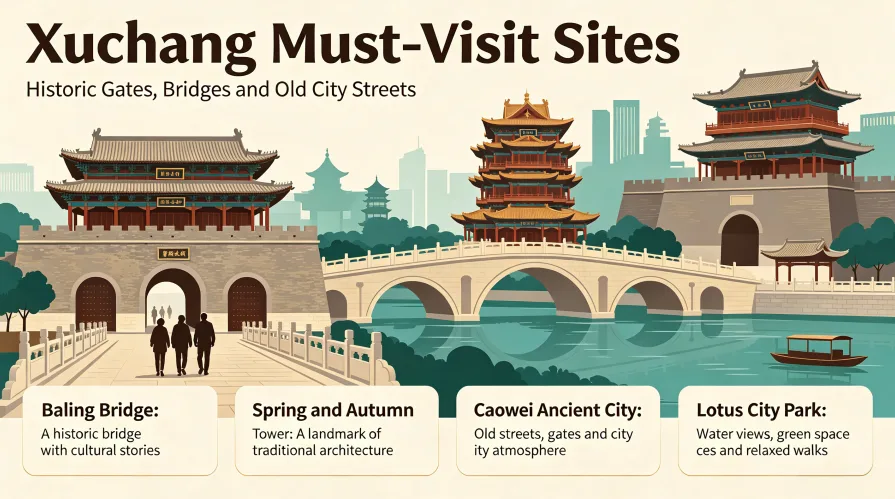
Detailed Introduction to Must‑See Attractions
Chunqiu Tower – Where Guan Yu Read the Spring and Autumn Annals at Night
Chunqiu Tower is the most famous Three Kingdoms cultural site in Xuchang, located in Weidu District, Xuchang. Legend says that when Guan Yu lived here, he often read the Spring and Autumn Annals by candlelight at night – hence the name “Chunqiu Tower.” The tower was first built in the Yuan dynasty; the existing buildings are in Ming and Qing style, forming a well‑preserved ancient architectural complex.
Core highlights:
- Main Hall: The central building, enshrining a seated statue of Guan Yu – solemn and mighty. The hall displays artifacts and historical materials related to Guan Yu, allowing visitors to learn about the life of this famous general, later honored as the “Saint of War.”
- Night Reading Statue: A vivid sculpture of Guan Yu reading by candlelight – a popular photo spot. The statue effectively shows Guan Yu’s image as both a warrior and a scholar.
- Stele Corridor: Preserves inscriptions by famous figures throughout history, including plaques and steles written by Emperors Kangxi and Qianlong of the Qing dynasty.
Practical information:
- Ticket: 25 RMB
- Opening hours: 8:00 – 17:30
- Recommended visit duration: 1.5–2 hours
Why you must go: Chunqiu Tower is a key landmark of Guan Yu culture and an important site for understanding Three Kingdoms history and the values of loyalty and righteousness.
Baling Bridge – Where Guan Yu Left Cao Cao
Baling Bridge is located on the northwestern outskirts of Xuchang. It is the historical site where Guan Yu parted from Cao Cao and rode away, famously “taking the robe with his spear.” According to the Romance of the Three Kingdoms, when Guan Yu learned of Liu Bei’s whereabouts, he resigned from Cao Cao’s service. Cao Cao personally escorted him to Baling Bridge and presented him with a robe. Guan Yu, suspecting a trap, used his Green Dragon Crescent Blade to take the robe without dismounting – leaving behind the famous story of “Guan Yu Taking the Robe.”
Core highlights:
- Ancient Bridge Ruins: The site retains stone bridge remains from the Ming and Qing dynasties – simple and rustic, surrounded by green trees and a peaceful environment. Standing on the bridge, you can imagine the scene of Guan Yu riding away while Cao Cao watched from afar.
- Robe‑Taking Pavilion: A replica pavilion commemorating the event, with a stone stele recording the story.
- Guandi Temple: Located by the bridge, dedicated to Guan Yu – with thriving incense.
Practical information:
- Ticket: 30 RMB
- Opening hours: 8:00 – 17:30
- Recommended visit duration: 1.5–2 hours
Why you must go: Baling Bridge is where the classic story of “Guan Yu Taking the Robe” took place. For Three Kingdoms enthusiasts, this is an unmissable historical site.
Cao Cao’s Prime Minister Residence – Cao Cao’s Office
Located in the center of Xuchang, Cao Cao’s Prime Minister Residence is a large replica complex built on the site of Cao Cao’s original residence, showcasing his political, military, and cultural life in Xuchang.
Core highlights:
- Cao Cao Statue: A bronze statue of Cao Cao in the main hall, displaying the commanding presence of this great strategist.
- Three Kingdoms Exhibition: Systematically presents the history of the late Eastern Han and Three Kingdoms periods, including Cao Cao’s achievements and the literary contributions of the “Seven Scholars of Jian’an.”
- Hidden Soldiers Cave: A replica underground military tunnel where you can experience the ingenious design of ancient defense facilities.
Practical information:
- Ticket: 60 RMB
- Opening hours: 8:00 – 17:30
- Recommended visit duration: 2 hours
Why you must go: This is the core landmark of Xuchang as the capital of the Cao Wei regime – essential for understanding Cao Cao and Three Kingdoms history.
Shenhou Ancient Town – The Birthplace of Jun Porcelain
Shenhou Ancient Town is located in Yuzhou City, Xuchang. It is the birthplace and main production center of Jun porcelain, one of the five great famous wares of the Song dynasty, and a National Historical and Cultural Town. Jun porcelain is renowned for its kiln‑transformation art – “one color in the kiln, ten thousand colors out of the kiln.”
Core highlights:
- Ancient Street: Preserves the street layout from the Ming and Qing dynasties, with traditional shops on both sides selling Jun porcelain crafts.
- Kiln Site: You can see ancient Jun porcelain kiln ruins and learn about traditional firing techniques.
- Jun Porcelain Experience Hall: You can try hand‑throwing and shaping your own piece of Jun porcelain.
Practical information:
- Town entry: Free (some attractions charge separately)
- Opening hours: Open all day
- Recommended visit duration: Half a day to a full day
- Access: About 1 hour by bus from Xuchang city.
Why you must go: Shenhou Ancient Town is the birthplace of Jun porcelain culture – suitable for ceramic enthusiasts and anyone wanting to experience a traditional Chinese ancient town.
Xuchang Museum – A Window to Xuchang’s History
Xuchang Museum is a national second‑level museum, displaying Xuchang’s history and culture from ancient times to the modern era.
Core highlights: “Xuchang Man” fossils (ancient human skull fossils dating back about 100,000 years); Three Kingdoms artifacts (including weapons, coins, and pottery); and a fine collection of Jun porcelain.
Practical information:
- Ticket: Free (reservation required in advance)
- Opening hours: 9:00 – 17:00 (closed on Mondays)
- Recommended visit duration: 2 hours
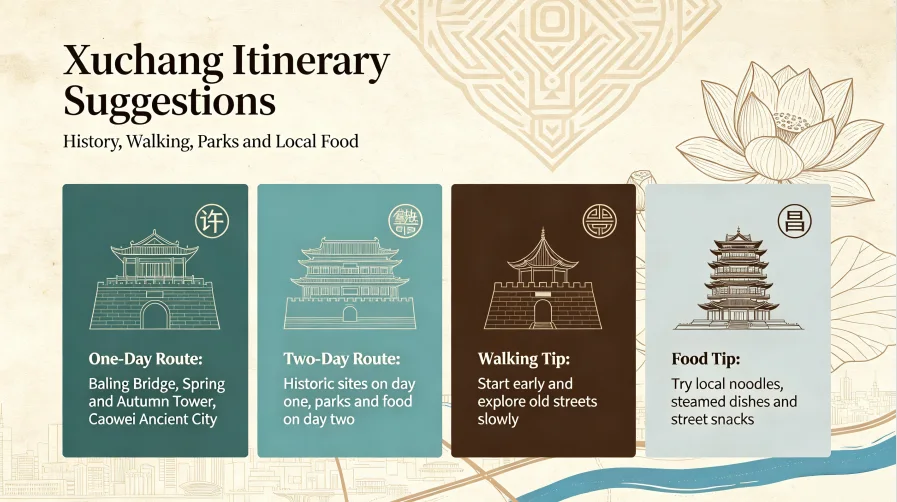
Suggested Itineraries for Xuchang
2‑Day Classic Tour (Three Kingdoms Culture + Shenhou Ancient Town)
- Day 1: Morning – visit Chunqiu Tower (1.5 hours) and Cao Cao’s Prime Minister Residence (2 hours). Lunch – try Xuchang specialties. Afternoon – visit Xuchang Museum (2 hours). Overnight in Xuchang city.
- Day 2: Morning – visit Baling Bridge (1.5 hours), then take a bus to Shenhou Ancient Town (about 1 hour). Explore the ancient street and kiln site (about 3–4 hours). Return in the evening.
3‑Day In‑Depth Tour (Add Hot Springs or Surroundings)
On the basis of the 2‑day tour, add a third day for hot springs (several hot spring resorts around Xuchang), or visit Yanling National Flower and Tree Expo Park (spring flower viewing), or Dahongzhai Scenic Area (hiking).
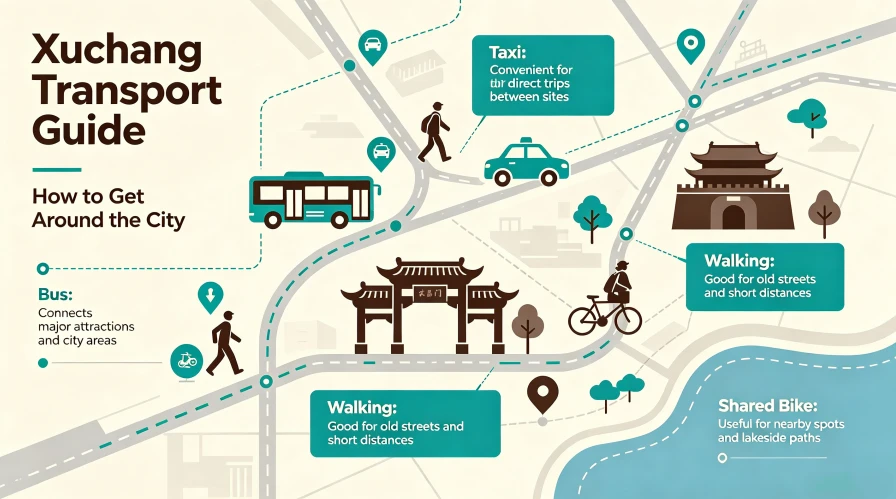
Transportation Guide for Xuchang
How to Get to Xuchang
- High‑speed train (most recommended) : From Zhengzhou East Station, take a high‑speed train to Xuchang East Station (about 30 minutes, fare about 40–50 RMB). After exiting, take a bus or taxi to the city.
- Regular train: Xuchang Station has regular trains connecting major cities.
- Long‑distance bus: Zhengzhou has buses to Xuchang (about 1.5 hours).
- Self‑drive: From Zhengzhou, take the Beijing–Hong Kong–Macau Expressway to the Xuchang exit – about 1.5 hours.
Getting around Xuchang
- Taxi: Starting fare 7 RMB; Didi Chuxing available.
- Bus: Fare 1 RMB – covers major attractions.
- To Shenhou Ancient Town: Take a bus from Xuchang Bus Station toward Yuzhou, get off at Shenhou Town – about 1 hour.
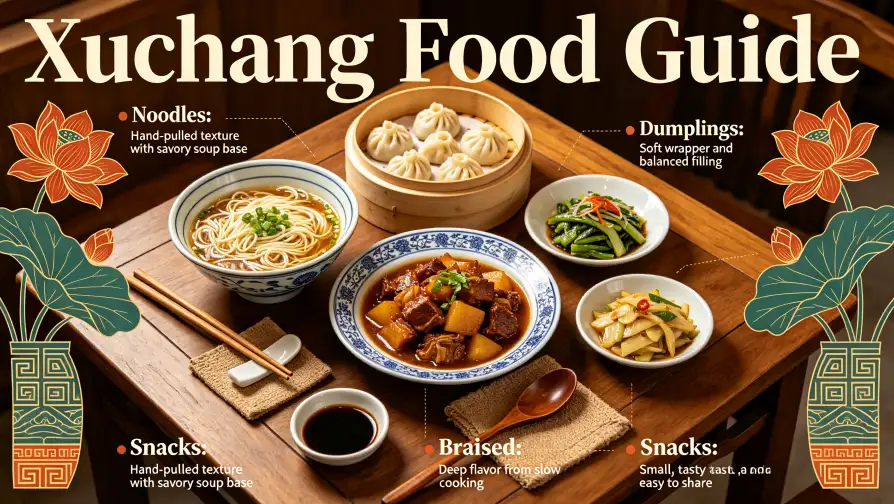
Xuchang Food Recommendations
Xuchang is in central Henan, and its cuisine blends the flavors of various parts of the Central Plains. The overall taste is savory and moderate – not spicy, very friendly to foreign visitors.
- Xuchang Braised Noodles (Huimian) : Similar to Zhengzhou’s version but with a richer broth and wider, thicker noodles.
- Yuzhou Vermicelli: Made from sweet potato starch – chewy and good for stews, cold dishes, or stir‑fries.
- Shenhou Tofu Feast: Tofu made with local spring water – rich soy flavor, prepared in many ways.
- Xuchang Menzi: A specialty snack made from sweet potato starch and meat broth – soft and sticky texture.
- Xuchang Roast Chicken: Similar to Daokou Chicken in style but with slightly different seasoning – another local specialty.
Food gathering places: Qiyi Road and Yingchang Avenue in Xuchang city, as well as the Wanda Plaza food court.
Accommodation Recommendations
- Xuchang city (Weidu District, Jian’an District) : Many choices. Recommended hotels: Xuchang Aviation Hotel, Quanji Hotel, Home Inn Business – prices 200–400 RMB.
- Shenhou Ancient Town: Characteristic guesthouses inside the town – traditional atmosphere – prices 150–300 RMB.
Booking tip: Use Booking.com, Agoda, or Trip.com. Check the “foreigners accepted” filter.

Practical Travel Tips for Xuchang
Language & Communication
Major attractions have English signs, but most local restaurants and taxi drivers speak only Chinese. Download a translation app and save the offline pack.
Payment & Money
WeChat Pay and Alipay are widely accepted. Carry a small amount of cash for street vendors.
Internet & SIM Cards
You can buy a short‑term SIM card (7–30 days) at Zhengzhou Airport or in Xuchang city using your passport.
Clothing & Gear
- Chunqiu Tower, Baling Bridge, and other sites are mostly indoors or in park areas – wear comfortable clothes.
- Shenhou Ancient Town has cobblestone streets – wear comfortable shoes.
- Summer: bring a sun hat and water. Winter: wear a warm coat.
Safety & Health
- Xuchang has good public security, and attractions are well managed.
- It is recommended to purchase travel insurance.
Frequently Asked Questions about Xuchang
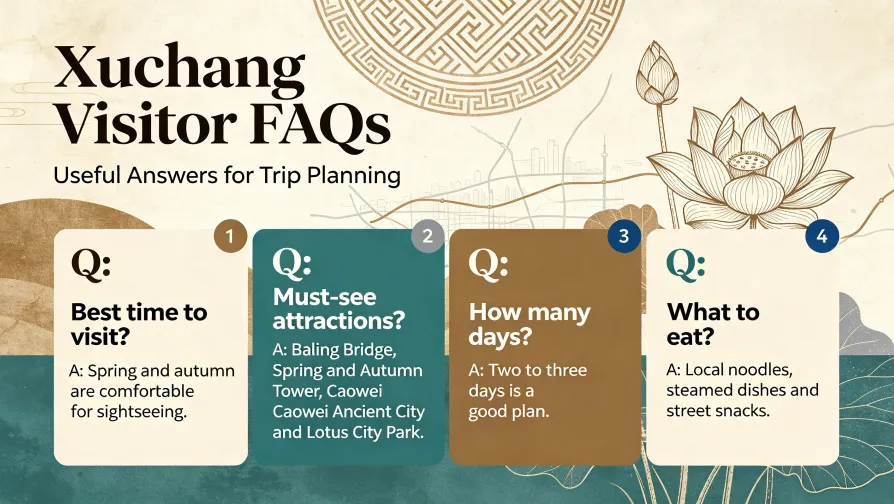
Q: How many days do I need for Xuchang?
A: At least 2 days to cover the core Three Kingdoms sites and Shenhou Ancient Town.
Q: What is the connection between Xuchang and the Romance of the Three Kingdoms?
A: Xuchang was the de facto political center of the late Eastern Han dynasty. Cao Cao held the emperor here and commanded the nobles – it was one of the most important stages of Three Kingdoms history. Chunqiu Tower and Baling Bridge are both related to Guan Yu.
Q: Is Jun porcelain expensive in Shenhou Ancient Town?
A: Prices range from tens of RMB to tens of thousands. You can buy small pieces as souvenirs – affordable and beautiful.
Q: Are there English‑speaking guides in Xuchang?
A: Chunqiu Tower and Cao Cao’s Prime Minister Residence can arrange English guides in advance – check with Trip.com or local travel agencies.
Xuchang is a city that perfectly combines Three Kingdoms history with Jun porcelain culture. Here, you can walk into the tower where Guan Yu read the Spring and Autumn Annals, step onto the ancient bridge where he took the robe from Cao Cao, touch the remains of Cao Cao’s residence, and explore the ancient town where Jun porcelain was born. Xuchang does not have the hustle and bustle of a big city, but it has a historical depth that has accumulated over a thousand years. Whether you are a Three Kingdoms enthusiast, a ceramic lover, or a traveler eager to understand Chinese history and culture, Xuchang will offer you a unique and memorable travel experience.
Plan your journey to Xuchang – and explore the land where the heroes of the Three Kingdoms once lived!
Related Reading:
- Anyang Attractions: Top 5 Must-Visit Places & Travel Guide 2026
- Anyang Food Guide 2026: Daokou Chicken, Bianfen Noodles & Local Delicacies
- Anyang Travel Guide 2026: Yinxu, Oracle Bones, Red Flag Canal & Itinerary
- Pingdingshan Travel Guide 2026: Yaoshan Mountain, Giant Buddha & Itinerary
- Yuntai Mountain Guide 2026: Red Stone Gorge, Waterfall & Itinerary
- Jiaozuo Travel Guide 2026: Yuntai Mountain, Tai Chi Village & Itinerary
- Dengfeng Travel Guide 2026: Shaolin Temple, Mount Song & Itinerary
- Luoyang Travel Guide 2026: Top Attractions, Food & Tips for Foreigners
- Henan Travel Guide 2026: Itinerary, Attractions & Tips for Foreigners
- What is the Specialty of Henan Food? A Foreigner’s Guide to Henan Cuisine
- Zhengzhou Nightlife Guide 2026: Best Bars, Night Markets & Foreigners



One Comment