

Jiaozuo Travel Guide 2026: Yuntai Mountain, Tai Chi Village & Itinerary
Jiaozuo Travel Guide 2026
Jiaozuo, located in northwestern Henan Province at the southern foot of the Taihang Mountains, is a city famous worldwide for Yuntai Mountain and Tai Chi. It is home to Yuntai Mountain, a UNESCO Global Geopark with unique canyon scenery, and Chenjiagou, the birthplace of Tai Chi. For foreign travelers, Jiaozuo offers an excellent combination of magnificent natural landscapes, martial arts culture, and authentic local food. This guide provides complete information on transportation, attractions, itineraries, food, and accommodation.
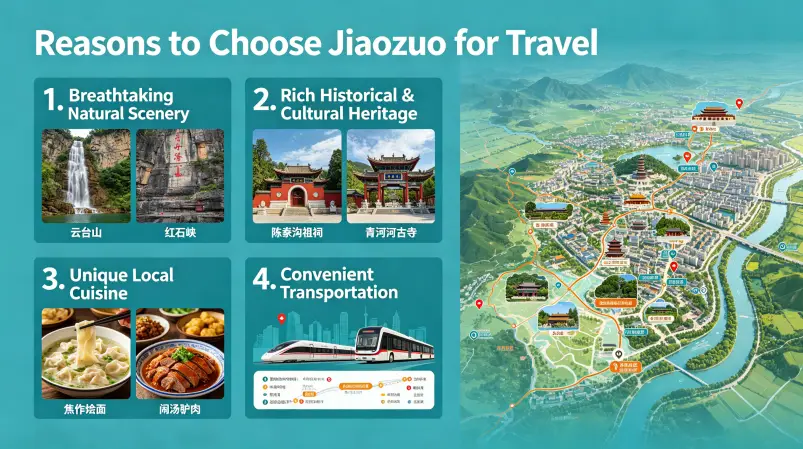
Why Choose Jiaozuo?
The main attraction of Jiaozuo is Yuntai Mountain – one of the first UNESCO Global Geoparks and a national 5A scenic area. Its Red Stone Gorge is known as the “No. 1 Canyon in China,” and the Yuntai Waterfall has a drop of 314 meters (1,030 feet), making it the highest single‑drop waterfall in Asia. Additionally, you can visit Chenjiagou, the birthplace of Tai Chi, to experience the deep culture of this martial art.
Jiaozuo is also home to other 5A scenic areas: Qingtian River (called the “Northern Three Gorges”), Shennong Mountain (famous for its “Dragon Ridge Great Wall” and Taihang macaques), as well as Jiaying Temple (the “Yellow River Forbidden City” built by the Yongzheng Emperor). In 2026, Jiaozuo launched a “One Ticket to Visit Jiaozuo” promotion: with a Yuntai Mountain ticket, you can visit Shennong Mountain, Qingtian River, Chenjiagou, and other nearby attractions for free or at half price within 7 days. Compared to other popular tourist cities in Henan, Jiaozuo has lower visitor density and more affordable travel costs.
Best Time to Visit
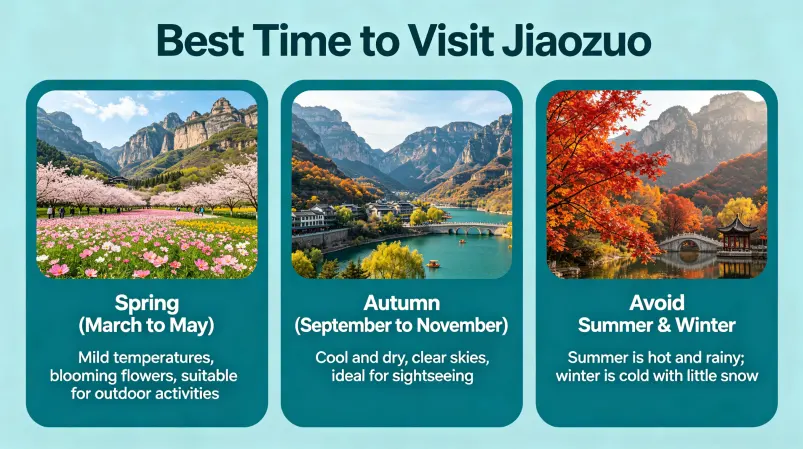
- Spring (April–May): Temperatures 15–25°C (59–77°F). Mountains are covered with blooming flowers, waterfalls become fuller – good for hiking and photography.
- Autumn (September–October): Clear skies and cool weather. The red leaves on Yuntai Mountain and Qingtian River are spectacular, especially from late October to early November when nearly 10,000 acres of Taihang red leaves reach their peak at Qingtian River.
- Summer (June–August): Yuntai Mountain is a summer resort. The Yuntai Waterfall is at its most magnificent. Protect yourself from the sun and be prepared for afternoon showers.
- Winter (December–February): Few tourists. Yuntai Mountain features icefalls and snowscapes, but some cable cars may close due to weather.
- Avoid: Chinese public holidays (National Day Golden Week, Oct 1–7, May Day). Attractions become extremely crowded, and the experience is much less enjoyable.
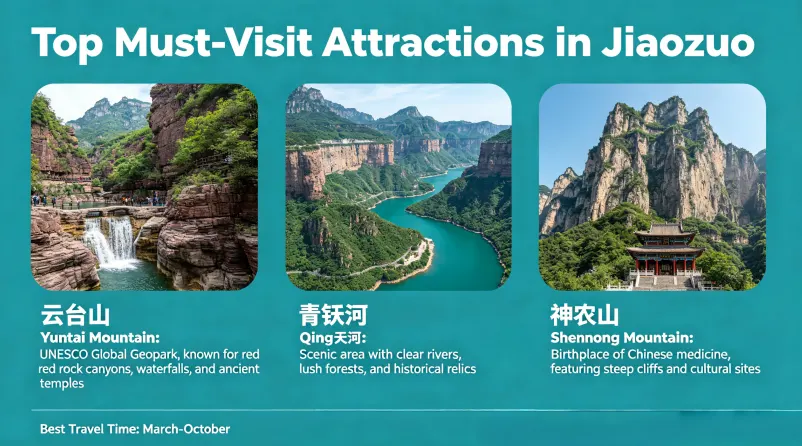
Detailed Introduction to Must‑See Attractions
Yuntai Mountain Scenic Area
Yuntai Mountain is Jiaozuo’s top attraction, covering a total area of 240 square kilometers (93 square miles). It includes 11 scenic spots: Red Stone Gorge, Tanpu Gorge, Quanpu Gorge, Zhuyu Peak, Diecai Tunnel, Macaque Valley, Zifang Lake, Wanshan Temple, Qinglong Gorge, and Fenglin Gorge. It is recommended to arrange 2 days for the visit.
Red Stone Gorge – No. 1 Canyon in China
Red Stone Gorge is about 2 km (1.2 miles) long, named for its rust‑red rocks. It reaches a depth of 68 meters (223 feet) underground and is known as a “bonsai canyon.” The trail is one‑way and takes about 1.5 hours to walk. Along the way, you will see White Dragon Waterfall, One‑Line Sky, Black Dragon Pool, and more. The best time to visit is around 8 AM, when sunlight shines into the gorge at an angle, making the red rock walls glow brilliantly.
Quanpu Gorge & Tanpu Gorge – A World of Waterfalls and Springs
At the end of Quanpu Gorge is the Yuntai Waterfall, with a drop of 314 meters (1,030 feet) – the highest single‑drop waterfall in Asia. It is most impressive during the rainy season. Tanpu Gorge is about 2 km long, known for “a spring every three steps, a waterfall every five steps, and a pool every ten steps.” It contains the “Everlasting Spring,” whose water is clean and refreshing.
Zhuyu Peak – Climb for a Distant View
Zhuyu Peak, at an altitude of 1,308 meters (4,291 feet), is the highest point of Yuntai Mountain. The Tang dynasty poet Wang Wei wrote a famous poem here that includes the line: “I know my brothers would climb the peak today, each with a zhuyu plant in his hair, thinking of me far away.” You can take a cable car or climb 1,667 steps to the summit for a panoramic view of the Taihang mountain range.
Macaque Valley & Zifang Lake
Macaque Valley is home to many wild Taihang macaques. They are lively and curious, but do not feed or provoke them. Zifang Lake is said to be where Zhang Liang (courtesy name Zifang), a famous minister of the Han dynasty, lived in seclusion. You can take a boat ride on the lake.
Yuntai Mountain Night Tour
Open in summer, the Yunxi Valley Night Tour is a new highlight. It is 1.2 km (0.75 miles) long and uses sound, light, electricity, and holographic projection to create an immersive light show. During the night tour, the nearby Anshang Town lights up with lanterns, offering food and creative market stalls.
Practical information:
- Ticket: 120 RMB. Scenic area shuttle bus: 60 RMB (strongly recommended, valid for 3 days).
- Opening hours: Peak season 6:30–18:00, off‑season 7:00–17:30.
Qingtian River Scenic Area
The Qingtian River is located in Bo’ai County. It is known as the “Northern Three Gorges” because it combines the grandeur of northern mountains with the softness of southern rivers. The core areas include Daquan Lake (boat tours available), Guanyin Gorge, and Fo’er Gorge. In autumn, Jinjialing offers nearly 10,000 acres of red leaves on the Taihang Mountains – an excellent place for photography. The red leaf season lasts from late September to late November, with the best time from late October to early November.
Shennong Mountain Scenic Area
Shennong Mountain is located in Qinyang City. Its name comes from the legend that the Yan Emperor (Shennong) distinguished grains and tasted herbs here. The main peak, Zijin Peak, is 1,028 meters (3,373 feet) high. On the way up, you will see the “Dragon Ridge Great Wall” – a natural stone ridge stretching 11.5 km (7.1 miles) along the mountain crest, resembling a giant dragon. The mountain is covered with white‑barked pines and is home to more than 3,000 Taihang macaques. You can take a sightseeing bus and cable car to the top with ease.
Chenjiagou – Birthplace of Tai Chi
Chenjiagou is located in Wen County. It is the birthplace of Tai Chi (Taijiquan). During the Hongwu period of the Ming dynasty, the Chen family moved here and developed their family martial art into Chen‑style Tai Chi, which is now a UNESCO Intangible Cultural Heritage. The scenic area includes the Tai Chi Ancestral Temple, the Memorial Hall of Grand Masters, and the site where Yang Luchan learned Tai Chi. Visitors can watch Tai Chi performances or book an experience class to learn basic movements from a lineage holder. Practicing Tai Chi early in the morning on the training platform at Donggou gives a special sense of history. In 2026, interactive robot Tai Chi shows were introduced, blending tradition with technology.
Jiaying Temple – “Yellow River Forbidden City”
Jiaying Temple was first built in 1723 AD (the first year of the Yongzheng era of the Qing dynasty). The Yongzheng Emperor ordered it built as a Dragon King temple to control the Yellow River floods. Because its architecture imitates that of the Forbidden City in Beijing, it is also called the “Yellow River Forbidden City.” Inside, you can see a copper stele inscribed by Emperor Yongzheng himself and precious relics related to river control – an important place to learn about China’s history of Yellow River management.
Jiaozuo Film and Television City
A national 4A scenic area, this is the filming location for many TV series and movies, including Romance of the Three Kingdoms and Outlaws of the Marsh. It consists of the King Zhou of Zhou Palace area, the King Chu Palace area, and an ancient street area, allowing you to experience the architecture of ancient Chinese capitals.
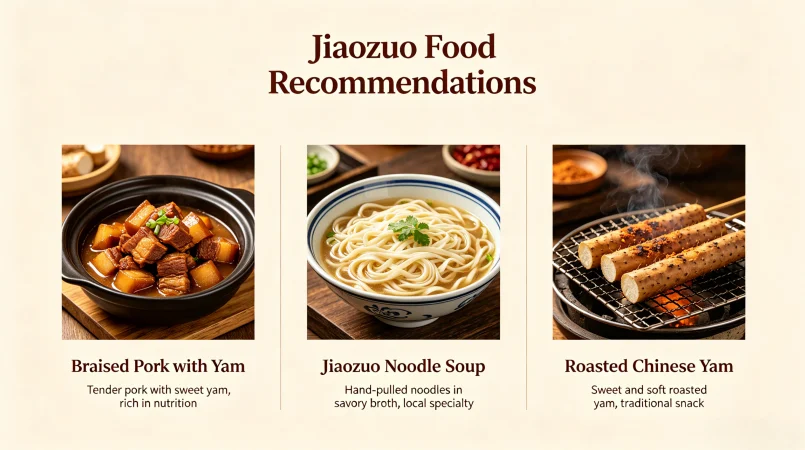
Jiaozuo Food Recommendations
The ancient Huaiqing Prefecture area, where Jiaozuo is located, has a rich food culture known for long‑simmered broths and noodle‑based dishes.
- Huai Mansion Simmered Donkey Meat: A century‑old specialty of Qinyang. Donkey meat is simmered in a “simmering soup” (a constantly boiling broth made with donkey bones and more than 30 spices). The meat is red, tender, and melts in the mouth. Best eaten thinly sliced with garlic vinegar dip.
- Iron Stick Yam (Tiegun Shanyao): Grown in Wen County, this is the “king” of Chinese yams, named for its rust‑like spots on the skin. It is firm, does not fall apart when cooked, and has a mild chestnut flavor when steamed. It is the first of the “Four Huai Medicines” (Huai rehmannia, Huai achyranthes, Huai yam, and Huai chrysanthemum). Recommended dishes: candied yams or yams stewed with pork ribs.
- Wuzhi Clay Pot Stew: Slowly cooked in a special small clay pot, the soup is rich and delicious. Before serving, hot chili oil is poured over it to release a fragrant aroma.
- Bo’ai Mixed Stew: A braised dish mixing crispy pork slices, wood ear mushrooms, bamboo shoots, and other ingredients – savory and rich.
- Haichan Palace Preserved Egg: A traditional specialty of Wuliyuan, Xiuxiu County, with an 800‑year history. It was once a tribute to the Song dynasty court. The egg white is crystal clear, the yolk is soft and creamy, with clear pine‑branch patterns. Best eaten with shredded ginger and vinegar.
Food gathering places:
- Jiaozuo city: Several local restaurants on Fengshou Road in Shanyang District and Minzhu Road in Jiefang District.
- Yuntai Mountain Anshang Service Area: Many farm‑style restaurants serving mountain dishes like yams and free‑range chicken.
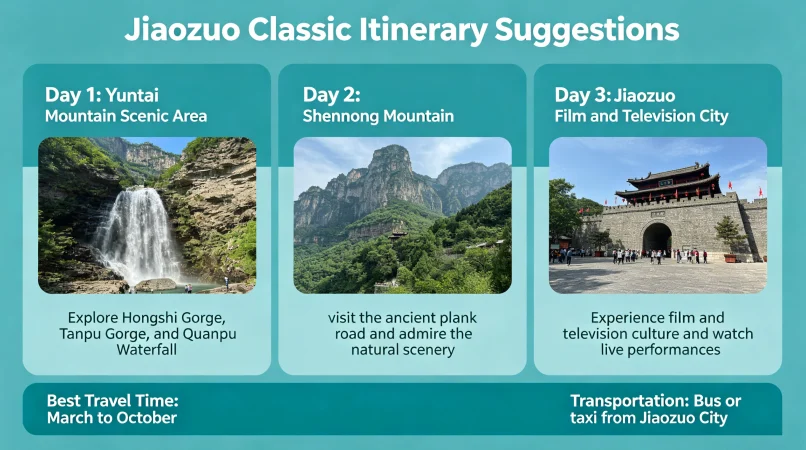
Suggested Itineraries
Option 1: 3‑Day Essential Tour (Yuntai Mountain + City Food)
- Day 1: Arrive in Jiaozuo in the morning, check into a guesthouse in the Anshang Service Area. Afternoon: visit Red Stone Gorge (2 hours), Macaque Valley, and Zifang Lake. Evening: Yunxi Valley Night Tour or Anshang Town night market.
- Day 2: Morning: visit Quanpu Gorge (2.5 hours) and Tanpu Gorge (2 hours). Afternoon: take the cable car to Zhuyu Peak and the glass skywalk.
- Day 3: Morning: visit Wanshan Temple. Noon: return to Jiaozuo city to taste Huai Mansion’s simmered donkey meat, iron-stick yam, and other specialties. Afternoon: visit Jiaozuo Museum or Jiaozuo Film and Television City. Return in the evening.
Option 2: 4–5 Day In‑Depth Tour (Covering all of Jiaozuo)
Add to the 3‑day itinerary:
- Day 4: Morning: go to Qingtian River, take a boat on Daquan Lake, then go to Jinjialing to see the red leaves. Afternoon: head to the Shennong Mountain area for an overnight stay.
- Day 5: Morning: climb Shennong Mountain’s Zijin Peak, admire the Dragon Ridge Great Wall, and see the Taihang macaques. Afternoon: go to Chenjiagou in Wen County to experience Tai Chi culture. Return in the evening.
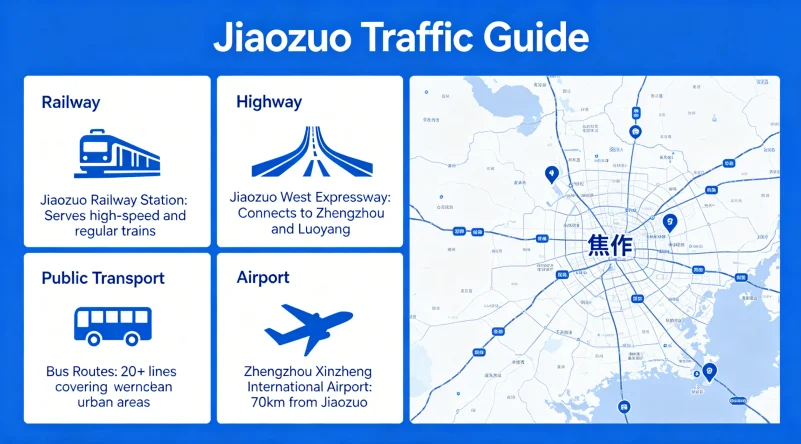
Transportation Guide
How to Get to Jiaozuo
- High‑speed train/bullet train (most recommended): From Zhengzhou East Station or Zhengzhou Station, take a high‑speed train to Jiaozuo Station or Jiaozuo West Station. Travel time: about 50–60 minutes, dozens of trains daily. After exiting the station, there is a direct tourist bus to Yuntai Mountain (about 1.5 hours, fare 25–35 RMB).
- Long‑distance bus: Zhengzhou Central Bus Station has buses to Jiaozuo (about 2 hours).
- Self‑driving: From Zhengzhou, take the Zhengzhou–Yuntai Expressway to the Xiuxiu exit. The whole drive takes about 1.5 hours—parking fee at the scenic area: about 20 RMB per day.
Transportation within Jiaozuo and to Scenic Areas
- Yuntai Mountain internal shuttle: 60 RMB for a 3‑day unlimited ride pass, connecting 14 stops including Red Stone Gorge, Quanpu Gorge, and Zhuyu Peak. Zhuyu Peak cable car: one way 70 RMB, round trip 120 RMB. Fenghuangling glass skywalk: extra 20 RMB.
- Taxi / ride‑hailing: Starting fare in the city is 7–8 RMB. Didi Chuxing is available.
- Bus: Bus No. 3 goes from Jiaozuo Station directly to Yuntai Mountain (fare 4 RMB, about 1.5 hours).
- Getting to Shennong Mountain, Qingtian River, Chenjiagou: Take a direct bus from Jiaozuo Tourist Bus Station, or use Didi. One way takes about 1–1.5 hours.
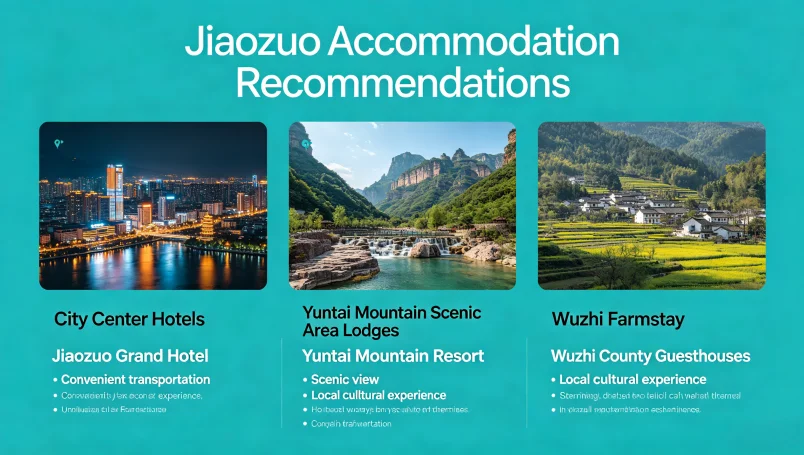
Accommodation Recommendations
- Anshang Service Area (inside Yuntai Mountain): Closest to Red Stone Gorge and Quanpu Gorge, with many guesthouses. Weekday rates: 180–260 RMB for a standard room. Prices double on weekends and holidays. Staying inside the scenic area allows you to enter core attractions early, before the crowds.
- Xiuxiu County: About a 20‑minute drive from Yuntai Mountain. Stable prices, more dining options. Budget hotels: 150–250 RMB per night.
- Jiaozuo city: Recommended if your itinerary includes Chenjiagou or Shennong Mountain. Stay in Shanyang District or Jiefang District, mainly mid‑range business hotels. Prices: 200–400 RMB per night.
Booking tip: Use Booking.com, Agoda, or Trip.com. Check the “foreigners accepted” filter.
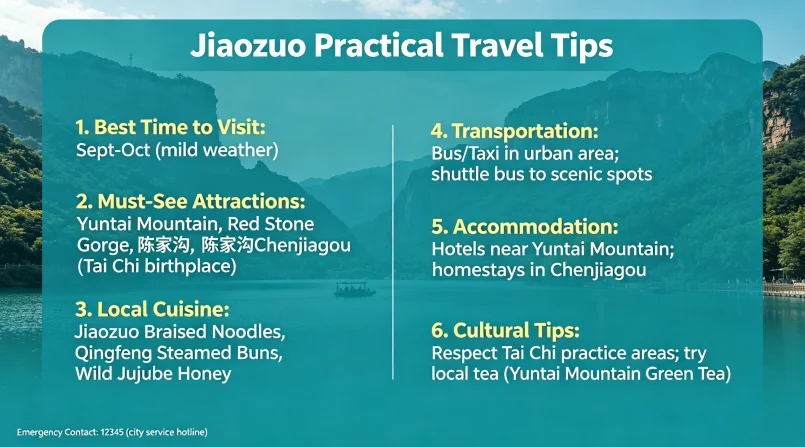
Practical Travel Tips
Language & Communication
Major scenic areas have bilingual (Chinese‑English) signs, but most local restaurants and taxi drivers speak only Chinese. Download Google Translate or Microsoft Translator in advance and save the offline Chinese pack. Learn a few key words: hello, thank you, how much, this one.
Payment & Money
WeChat Pay and Alipay are widely accepted for tickets, shuttle buses, restaurants, and night markets. Link an international credit or debit card before you go. Also carry a small amount of cash (200–300 RMB) for small vendors and emergencies.
Internet & SIM Cards
Buy a short‑term SIM card (7–30 days) from China Mobile, China Unicom, or China Telecom at the airport or official stores with your passport. Price: about 50–150 RMB. Hotels and restaurants usually offer free Wi‑Fi.
Clothing & Gear
- Must wear non‑slip hiking or sports shoes. Trails at Yuntai Mountain and Shennong Mountain have many stone steps, which can be slippery after rain.
- Summer: sun‑protective clothing, sun hat, insect repellent, and plenty of water.
- Spring/Autumn: bring a light jacket; mornings and evenings in the mountains are cool.
- Winter: down jacket, scarf, and gloves to keep warm.
Safety & Health
- Jiaozuo has good public security. However, when visiting Macaque Valley, keep a safe distance from wild macaques – do not feed or provoke them.
- The mountain roads have many curves. If driving, control your speed.
- Do not drink tap water – buy bottled water at scenic areas or hotels.
- It is recommended to purchase travel insurance that covers China.
Ticket Booking & Discounts
From March 27, 2026, Yuntai Mountain requires online real‑name booking. It is recommended to book tickets in advance on the official mini‑program or platforms like Trip.com and Meituan. Throughout 2026, with a Yuntai Mountain ticket, you can visit Shennong Mountain, Qinglong Gorge, and Fenglin Gorge for free within 7 days, and enjoy 50% off on tickets for Qingtian River, Chenjiagou, and Jiaozuo Film and Television City. Be sure to keep your ticket stub.
Frequently Asked Questions
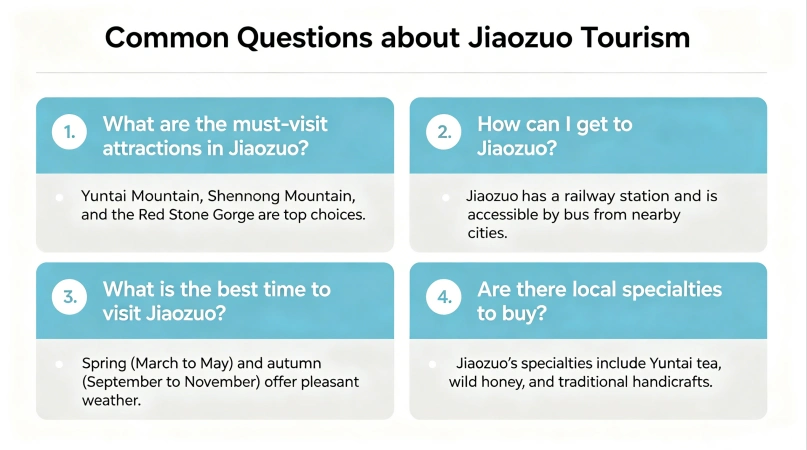
Q: How many days do I need for Yuntai Mountain?
A: At least 2 days. A one‑day trip only allows a glance at the core area – you will miss Quanpu Gorge, Zhuyu Peak, Macaque Valley, and other highlights.
Q: What does “ticket valid for 3 days” mean for Yuntai Mountain?
A: After purchase, you can enter and exit the scenic area unlimited times over 3 consecutive days, and the shuttle bus is also unlimited. This is very convenient for visitors staying inside the area and exploring over several days.
Q: Can I experience Tai Chi at Chenjiagou?
A: Yes. The scenic area offers Tai Chi experience classes, as well as live performances and teaching by lineage holders. It is recommended to go in the morning for the best experience.
Q: What are good souvenirs to bring home from Jiaozuo?
A: Vacuum‑packed Huai Mansion simmered donkey meat, iron stick yam (fresh yams may be subject to customs restrictions – buy processed products), Haichan Palace preserved eggs, Wuzhi oil tea, and products made from the Four Huai Medicines. These are available at specialty shops in the city and scenic area shops.
Final Words
Jiaozuo is a city that blends the magnificent landscapes of the Taihang Mountains with the profound culture of Tai Chi. From the red rock wonders of Red Stone Gorge to the powerful cascade of Yuntai Waterfall, from the rugged Dragon Ridge Great Wall at Shennong Mountain to the romantic red leaves of Qingtian River, and then to the quiet power of Tai Chi in Chenjiagou, Jiaozuo offers foreign travelers an immersive journey into China’s natural beauty and cultural heritage.
Whether you are an explorer of geological wonders or a seeker of Tai Chi culture, Jiaozuo is worth a special trip. Start planning your journey to Jiaozuo and discover this hidden landscape treasure in the heart of Central China!
Related Reading:
- 2026 Dengfeng Food Guide: Shaolin Veggie Delights & Local Snacks
- 2026 Luoyang Food Guide: Best Local Dishes, Water Banquet & Night Market Tips
- Dengfeng Travel Guide 2026: Shaolin Temple, Mount Song & Itinerary
- Zhengzhou to Kaifeng Day Trip 2026: Itinerary, Transport & Night Market Tips
- Luoyang Travel Guide 2026: Top Attractions, Food & Tips for Foreigners
- Henan Travel Guide 2026: Itinerary, Attractions & Tips for Foreigners
- Kaifeng Food Guide 2026: Top 10 Must-Try Dishes
2 Comments