
Anyang Food Guide 2026: Daokou Chicken, Bianfen Noodles & Local Delicacies
Anyang Food Guide 2026
Anyang, a city in the northernmost part of Henan Province, is one of China’s eight great ancient capitals. It is the birthplace of Oracle Bone Script and the spiritual home of the Red Flag Canal. Its long history and unique location have given rise to a rich and distinctive food culture. Here you will find the “No. 1 Chicken in China” – Daokou Roast Chicken – as well as the lively street dishes of Bian Fen Cai and Neihuang Stuffed Sausage, plus mountain flavors from the Taihang Mountains. Anyang cuisine is savory, rich, honest, and affordable, strongly influenced by the culinary traditions of northern Henan and southern Hebei. For foreign visitors, exploring Anyang’s food is a taste journey into the ancient flavors and folk wisdom of the Central Plains. This guide recommends the best local specialties, where to find them, and practical tips.
Three Key Features of Anyang Cuisine
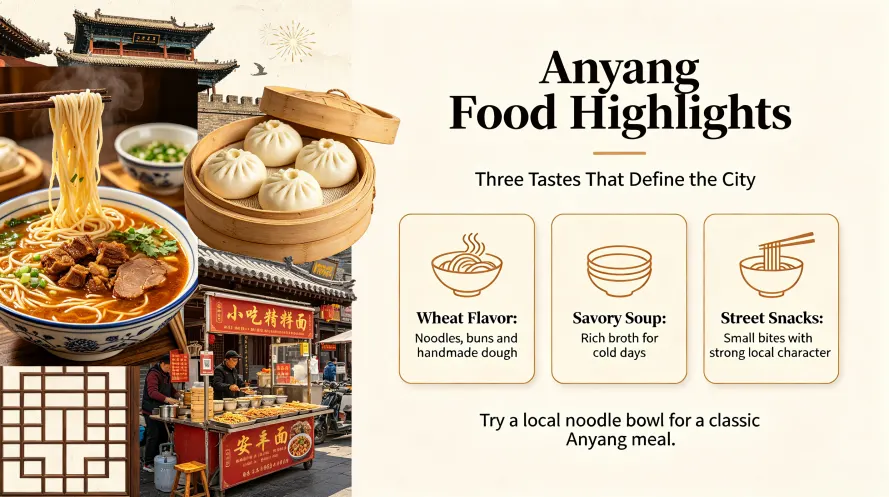
Anyang is in northern Henan, with the Taihang Mountains to the west and plains to the east. Its food culture combines the richness of the Central Plains with the rustic simplicity of the mountains. First, Anyang is a center of braising and roasting – Daokou Roast Chicken is the outstanding example, with its complex techniques and deep flavors. Second, locals love honest, home‑style tastes – dishes like Bian Fen Cai and mixed stews use the most ordinary ingredients, slowly simmered and seasoned to create heartwarming flavors. Third, the Taihang Mountains supply abundant wild vegetables and grains – wild leeks, wild mushrooms, and millet – which are important on Anyang tables. The overall taste is savory and rich, but not spicy – very friendly to most foreign visitors.
Must‑Try Anyang Dishes
Daokou Roast Chicken – The No. 1 Chicken in China
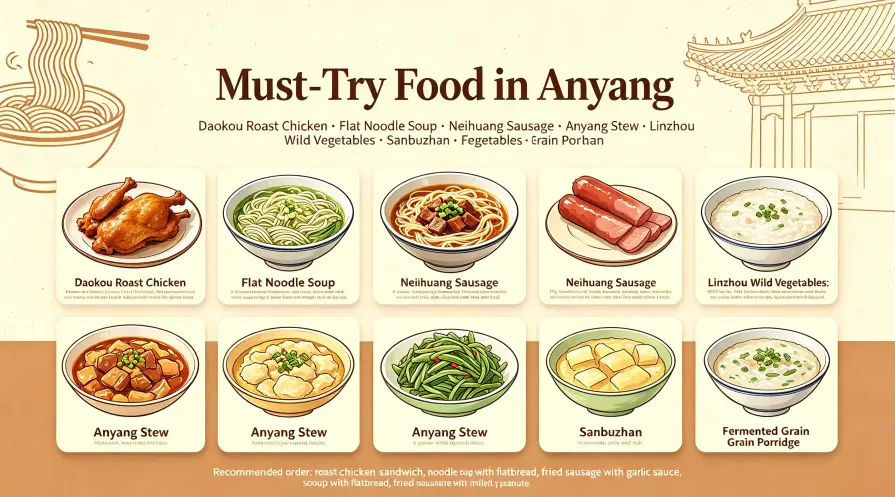
Daokou Roast Chicken is the most famous roast chicken in Anyang and across China. It comes from Daokou Town, Huaxian County, Anyang, and is known as the “No. 1 Chicken in China.” Its history dates back to the Shunzhi period of the Qing dynasty (1644–1661) – over 300 years ago. The chicken is made from high‑quality live birds, braised with a variety of precious spices in a master stock. The finished product is glossy red, beautifully shaped (like a gold ingot), and the meat is so tender it falls off the bone with a gentle shake of the hand.
- Why it’s so special: The secret lies in the master stock and the cooking time. The stock is aged for decades or even centuries, constantly topped up with fresh ingredients, creating an incredibly complex flavor. The chicken is slowly braised for hours, absorbing all the flavors, and even the bones become fragrant and crispy – no need to tear or chew hard.
- How to eat: Daokou Chicken can be eaten hot or cold. The classic way is to tear it by hand and dip it in Sichuan pepper salt or garlic vinegar sauce. You can also shred the meat and put it in a flatbread to make a chicken sandwich.
- Recommended places: Yixing Zhang Daokou Chicken specialty shops in Anyang city (several branches); the original Yixing Zhang shop in Daokou Town, Huaxian County.
- Price: About 60–90 RMB for a whole chicken (depending on size).
Anyang Bian Fen Cai – A Hearty Morning Breakfast
Bian Fen Cai is one of the most representative breakfasts in Anyang. Its main ingredient is wide, flat sweet potato vermicelli, cooked with tofu, pig blood (blood curd), and green vegetables (usually small cabbage or spinach) in a large iron pot with pork bone broth. It is simmered, and before serving, garlic and coriander are sprinkled on top – steaming hot and fragrant.
- Why try it: Bian Fen Cai is a snapshot of daily life in Anyang – simple, warm, and filling. The vermicelli soaks up the savory broth, becoming chewy and smooth; the tofu and pig blood absorb the rich flavors and become tender. The most authentic way is to eat it with a freshly baked flatbread, breaking the bread into pieces and soaking them in the soup.
- How to eat: When ordering, you can ask for “more vermicelli” or “more blood”. A bowl of Bian Fen Cai with a flatbread is the standard Anyang breakfast.
- Recommended places: Breakfast shops on the streets of Anyang, especially around Wenfeng Middle Road and North Street.
- Price: About 8–12 RMB per bowl.
Neihuang Stuffed Sausage – Crispy Outside, Soft Inside Street Classic
Neihuang Stuffed Sausage is a specialty snack from Neihuang County, Anyang, with a history of several hundred years. It is made by mixing pig blood, buckwheat or wheat flour, and spices, then stuffing the mixture into pig large intestines. After boiling, it is sliced and pan‑fried on a hot plate until both sides are golden and crispy.
- How it tastes: The fried sausage is crispy on the outside and soft on the inside. The combination of pig blood and buckwheat gives a unique texture and aroma. It is even better dipped in garlic vinegar sauce, rice vinegar, or chili oil.
- Recommended places: Street stalls in Neihuang County Town; North Street Night Market and Wanda Plaza food street in Anyang City also sell it.
- Price: About 10–15 RMB per serving.
Anyang Mixed Stew (Hui Cai) – Taste of Home
Anyang Mixed Stew is the local version of the Henan mixed stew. It brings together pork belly, tofu, vermicelli, cabbage, wood ear mushrooms, meatballs, and more in a rich broth, slowly simmered until the ingredients are soft and flavorful.
- Why it’s recommended: This dish captures the essence of Anyang home cooking – diverse ingredients, nutritious, and perfect for recharging after visiting Yinxu or the Red Flag Canal.
- Recommended places: Local home‑style restaurants in Anyang, such as Anyang Old Flavor and Yubei Restaurant.
- Price: Small portion about 30–40 RMB (serves 2).
Linzhou Mountain Vegetables – Gifts from the Taihang Mountains
Linzhou is the home of the Red Flag Canal, located in the Taihang Mountains, which produces a wide variety of wild vegetables – wild leeks, wild mushrooms, edible fungi, and more. These naturally grown ingredients are fresh and flavorful.
- Classic dishes: Stir‑fried wild leeks with scrambled eggs (fragrant), free‑range chicken stewed with wild mushrooms (tender and rich), and cold-dressed edible fungi (refreshing and appetizing).
- Recommended places: Farmhouse restaurants near the Red Flag Canal scenic area in Linzhou.
- Price: About 20–40 RMB per plate.
Anyang San Bu Zhan – A Century‑Old Imperial Dessert
San Bu Zhan is a traditional imperial pastry. Its name means “does not stick to the plate, does not stick to chopsticks, does not stick to teeth.” It is made by stir‑frying egg yolks, sugar, starch, and lard to a golden yellow color – soft, sweet, and slightly chewy.
- Recommended place: Time‑honored restaurants in Anyang, such as Jubin Lou.
- Price: About 30–45 RMB per serving.
Anyang Fen Jiang Zhou – A Unique Sour and Savory Porridge
Fen Jiang Zhou is a traditional Anyang staple. It uses fermented mung bean milk to cook millet, peanuts, and soybeans, resulting in a distinctive sour and savory flavor – similar to Luoyang’s Jiang Mian Tiao but with a different texture.
- Recommended places: Local home‑style restaurants or breakfast shops in Anyang.
- Price: About 8–12 RMB per bowl.
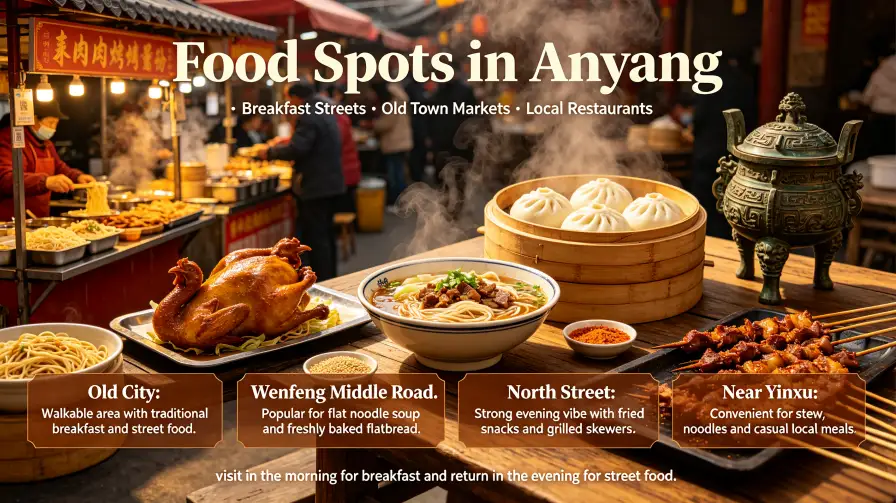
Recommended Food Gathering Places
Anyang City
- North Street Night Market: The most famous night market in Anyang, opening in the evening. Here you can try Neihuang Stuffed Sausage, grilled skewers, fried jelly, Daokou Chicken, and more.
- Wenfeng Middle Road Food Street: Many local restaurants and breakfast shops – good for Bian Fen Cai and mixed stews.
- Wanda Plaza (Anyang): On the 4th floor, a variety of standard restaurants with a comfortable ambiance.
Daokou Town, Huaxian County
- Daokou Chicken Street: The core area of Daokou Town, with many century‑old chicken shops. You can taste freshly cooked hot chicken on site.
Linzhou City
- Red Flag Canal farmhouse restaurants: Taste Taihang mountain vegetables, free‑range chicken, and local noodles.
Practical Tips
Taste and Spiciness
Anyang dishes are generally not spicy – they are savory and salty. Daokou Chicken has no chili; chili oil is provided separately. Bian Fen Cai’s broth is not spicy – you can add chili oil and vinegar yourself.
Ordering Recommendations
- One person: Half a Daokou Chicken (about 30–40 RMB) + a bowl of Bian Fen Cai (about 10 RMB), or a portion of Neihuang Stuffed Sausage (about 15 RMB) + a cold mountain vegetable salad (about 20 RMB).
- Two persons: One whole Daokou Chicken (about 60–80 RMB) + a small Anyang Mixed Stew (about 35 RMB) + a plate of wild leek scrambled eggs (about 25 RMB) + two portions of flatbread or rice.
- Souvenirs: Vacuum‑packed Daokou Chicken (about 60–90 RMB each); Anyang Pizha (a sweet potato‑based food, about 15 RMB per bag); Linzhou millet (about 10–20 RMB per 500 grams).
Payment and Language
Restaurants and night markets accept WeChat Pay and Alipay. Link an international credit or debit card in advance. For night market stalls, carry 50–100 RMB in cash. Some small restaurants do not have English menus – use a translation app or point at what the next table is eating.
Vegetarian Friendliness
Anyang has plenty of vegetarian options. Cold mountain vegetables, stir‑fried wild mushrooms, scrambled eggs with edible fungi, stir‑fried mixed vegetables, San Bu Zhan, and Fen Jiang Zhou (can be made without meat) are all vegetarian. When ordering, tell the server “I am vegetarian – no meat and no animal oil.”
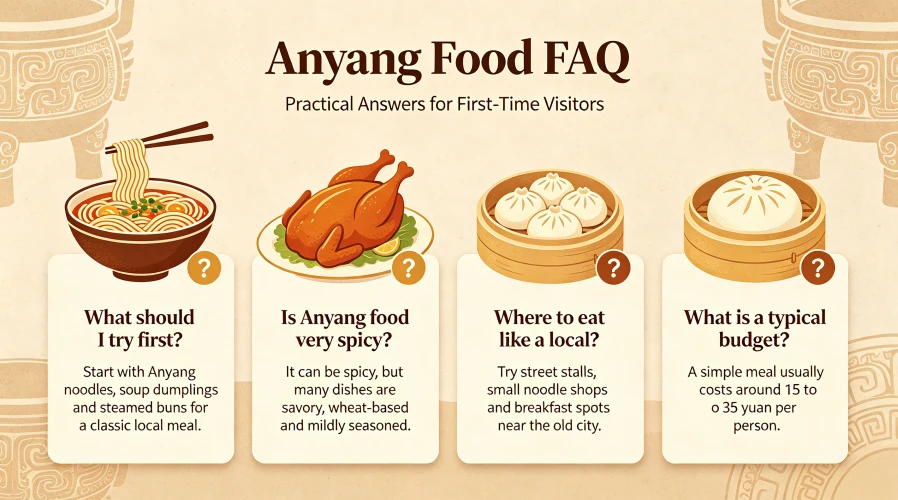
Frequently Asked Questions about Anyang Food
Q: What is the difference between Daokou Chicken and Peking Duck?
A: Daokou Chicken is braised and fully cooked – it can be eaten cold or hot, with tender, falling‑off‑the‑bone meat. Peking Duck is roasted and must be eaten hot, sliced thinly and served with pancakes and sweet bean sauce. They are completely different styles, but both are famous Chinese poultry dishes.
Q: Is Bian Fen Cai a soup or a dish?
A: It is somewhere between a soup and a dish. The vermicelli and ingredients are simmered in bone broth; the resulting liquid is rich and can serve as a main meal (with flatbread) or a side dish.
Q: What do you recommend for breakfast in Anyang?
A: Bian Fen Cai with flatbread is the classic Anyang breakfast. For something lighter, try millet porridge with pickles and flatbread.
Q: What souvenirs can I bring home from Anyang?
A: Vacuum‑packed Daokou Chicken, Anyang Pizha (a sweet potato‑based food), dried Linzhou mountain vegetables, and sealed Fen Jiang Zhou paste.
Q: Is the “sausage” in Neihuang Stuffed Sausage made from pig large intestine?
A: Yes – traditionally, pig large intestine is used as the casing. However, modern versions may use artificial casings. If you are not fond of the offal taste, dip it in garlic vinegar and vinegar – it effectively removes any unpleasant smell.
Anyang’s food, like its history, is deep and honest. From the century‑old master stock of Daokou Chicken, to the warm morning bowls of Bian Fen Cai, to the fresh and natural mountain vegetables – every dish tells the story of this land. Beyond the oracle bones of Yinxu and the grand engineering of the Red Flag Canal, the flavors of Anyang are equally worth savoring.
May you touch the pulse of 3,000‑year‑old civilization in Anyang, and also taste the folk flavors passed down through the centuries.
Related Reading:
- Anyang Travel Guide 2026: Yinxu, Oracle Bones, Red Flag Canal & Itinerary
- Pingdingshan Food Guide 2026: Must-Try Noodles, Stews & Local Delicacies
- Jiaozuo Food Guide 2026: Must-Try Dishes, Huai Mansion Donkey Meat & Iron Yam
- 2026 Dengfeng Food Guide: Shaolin Veggie Delights & Local Snacks
- 2026 Luoyang Food Guide: Best Local Dishes, Water Banquet & Night Market Tips
- Henan Travel Guide 2026: Itinerary, Attractions & Tips for Foreigners
- Kaifeng Food Guide 2026: Top 10 Must-Try Dishes
- What is the Specialty of Henan Food? A Foreigner’s Guide to Henan Cuisine
- Zhengzhou Night Market Guide: Food, Tips & Best Streets for Foreigners
- Zhengzhou Food Guide: Must-Try Dishes Like HuiMian & HuLaTang (2026)