
Pingdingshan Food Guide 2026: Must-Try Noodles, Stews & Local Delicacies
Pingdingshan Food Guide 2026
Pingdingshan, a city that rose with the coal industry and was named after its flat‑topped mountain, lies in central Henan Province. The Funiu Mountains border it to the west and the Huanghuai Plain to the east. This unique location blends mountain flavors with Central Plains culinary traditions, creating a simple, hearty, and authentic taste. You will find mountain delicacies, wheat‑based staples, and time‑honored local specialties here. For foreign visitors, exploring Pingdingshan’s food is a journey into the rustic charm of central Henan and genuine Chinese home cooking. This guide recommends the best local dishes, where to find them, and practical tips.
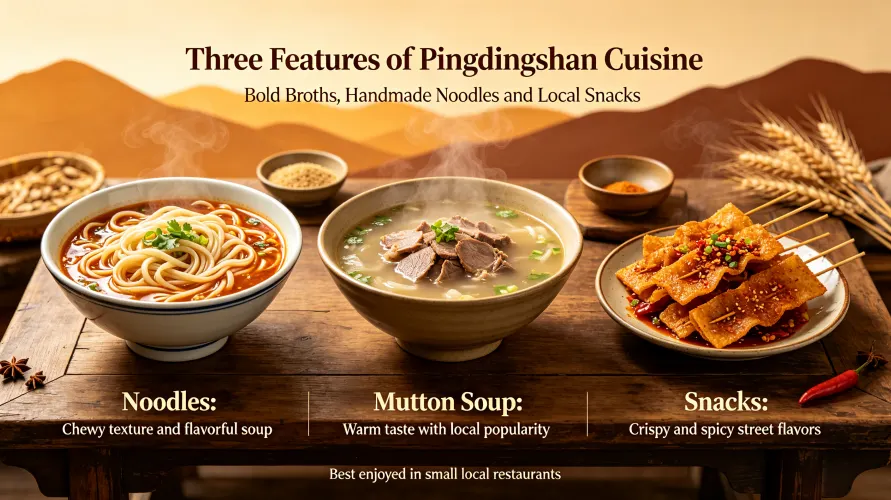
Three Key Features of Pingdingshan Cuisine
Pingdingshan cuisine can be summarized in three words: rustic, hearty, and rich. First, the Funiu Mountains provide abundant wild ingredients such as fiddlehead ferns (quancai), mountain mushrooms, wild rabbit, and pheasant. Second, as part of the Central Plains, wheat‑based foods – noodles, flatbreads, steamed buns – are central to every meal. Third, locals favor deep, savory flavors, using slow‑simmered broths, sauces, and various spices. The dishes are salty, rich, and very satisfying with rice or bread. The overall spiciness is low, so most foreign visitors will find the food easy to enjoy.
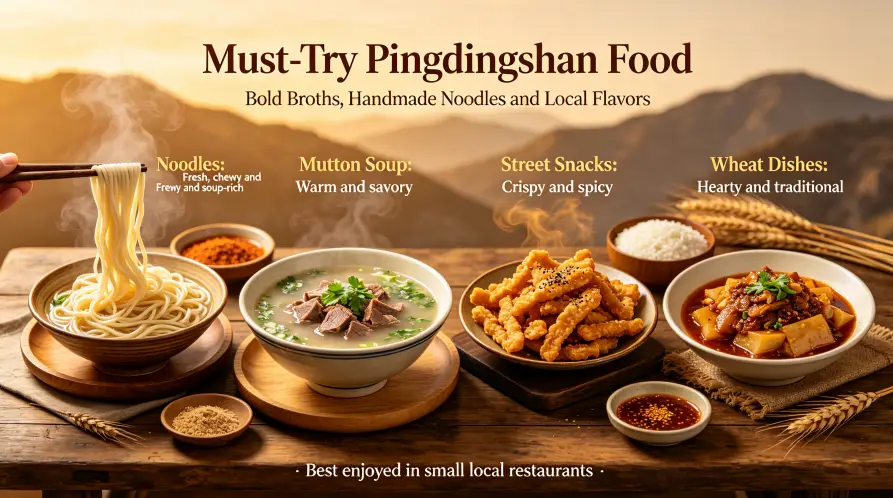
Must‑Try Pingdingshan Dishes
Jiaxian Hele Noodles – A Century‑Old Buckwheat Classic
Hele Noodles are the most famous traditional noodle dish of Jiaxian County, Pingdingshan, with a history of several hundred years. What makes them unique is that the noodles are pressed through a special “hele press” with a mixture of buckwheat and wheat flours, making them round and chewy. The broth is the soul of the dish – fresh mutton and bones are simmered for hours with more than 20 spices until milky white and richly aromatic.
- How to eat: The pressed noodles are boiled, placed in a bowl, and topped with piping hot mutton broth. Chopped green onions, coriander, chili oil, and garlic paste are added. You can also add an extra portion of mutton or offal. Take a sip of the broth first, then enjoy the chewy noodles in the flavorful soup.
- Recommended places: Zhang Ji Hele Noodles (a century‑old shop) in Jiaxian county town; Wang Ji Hele Noodles main store; Jiaxian Hele Noodle shops in Pingdingshan city (several branches).
- Price: About 12–18 RMB per bowl.
Lushan Lan Guo Cai – The Ultimate Mountain Mixed Stew
Lan Guo Cai is the signature dish of Lushan County, Pingdingshan, and a representative stew of the western Henan mountain region. “Lan” in the local dialect means “to mix or combine,” and this dish truly brings together a variety of ingredients. The main ingredients include pork belly, tofu, vermicelli, wood ear mushrooms, cabbage, radish, garlic sprouts, and about ten other items. They are slowly simmered in a rich broth, allowing the flavors to meld into a fragrant and hearty stew.
- How to eat: Usually served with steamed rice or flatbread. The pork belly is not greasy, the vermicelli absorbs the broth, and the tofu is soft and flavorful. A steaming pot of Lan Guo Cai is both a dish and a soup – warm and satisfying.
- Recommended places: Time‑honored Lan Guo Cai restaurants in Lushan county town (such as Zhao Jia Lan Guo Cai); Lushan Lan Guo Cai specialty shops in Pingdingshan city.
- Price: Small portion about 38–48 RMB (serves 2); large portion about 58–68 RMB (serves 3–4).
Baofeng Mutton Soup – Warmth from the Foot of the Funiu Mountains
Baofeng County, adjacent to Pingdingshan city, is famous for its mutton soup with fresh meat and a rich broth. Locally raised free‑range goats are used, with bones and meat simmered for hours in iron pots. The soup is clear or milky white (depending on the method), with few seasonings to highlight the natural flavor of the mutton. The meat is sliced thinly but generously, tender and not falling apart.
- How to eat: Sliced mutton is placed in a bowl, topped with boiling soup, and garnished with chopped green onions and coriander. Add salt, chili oil, and vinegar to taste. Locals like to pair it with Guokui (a thick baked flatbread) or Shaobing, breaking the bread into pieces to soak in the soup.
- Recommended places: Old Li Mutton Soup in Baofeng county town; Baofeng Mutton Soup main store in Pingdingshan city.
- Price: About 15–25 RMB per bowl.
Yexian Braised Noodles – A Central Henan Representative
Although braised noodles are a classic throughout Henan, Yexian Braised Noodles stand out in the Pingdingshan area. Compared to Zhengzhou’s version, Yexian noodles are wider and thicker, with a chewier texture. The broth, made from mutton and bones, is richer, and the toppings are more abundant – often including wood ear mushrooms, shredded tofu skin, quail eggs, and goji berries. The bowl is hearty and filling – perfect for recharging after hiking or long travel.
- Recommended place: Time‑honored Yexian Braised Noodle shops in Yexian county town (such as Wang Ji Braised Noodles).
- Price: About 15–20 RMB per bowl.
Wugang Hot Tofu – A Warm, Silky Street Snack
Wugang is a county‑level city under Pingdingshan. Its Hot Tofu is a local specialty. Unlike cold tofu dishes, the tofu is cut into thick blocks and kept warm in hot water. When served, it is topped with sesame paste, chili oil, garlic juice, and vinegar, then sprinkled with coriander and crushed peanuts. The tofu is silky and melts in the mouth, while the sauces are rich and fragrant. It is warm and comforting.
- Recommended places: Street food stalls in Wugang city, especially on Sipo Pedestrian Street and Yakou Market.
- Price: About 5–8 RMB per portion.
Lushan Quancai (Fiddlehead Fern) – A Gift from the Funiu Mountains
Quancai is a type of fiddlehead fern, named for its curled young shoots that resemble a fist. Lushan County, located in the heart of the Funiu Mountains, produces abundant wild quancai. Locals sun‑dry or pickle the shoots for preservation. To eat, they are rehydrated and can be served cold, stir‑fried with meat, or added to soups. The texture is crisp and refreshing, with a unique mountain aroma.
- How to eat: Recommended as stir‑fried quancai with shredded pork or cold quancai salad. This is the best way to experience Pingdingshan’s mountain flavors.
- Recommended places: Mountain‑flavor restaurants in Lushan county town; farmhouse restaurants at the entrance of Yao Mountain scenic area.
- Price: About 20–35 RMB per plate.
Ru Porcelain Tea Set and Xinyang Maojian Tea – An Elegant Cultural Experience
Although tea sets and tea are not “food,” in Pingdingshan, using a beautiful Ru porcelain tea set to brew a cup of Xinyang Maojian tea – a famous Henan tea – is an important way to experience local culture. Ru porcelain originates from Baofeng County, Pingdingshan, and is famous for its sky‑blue glaze and “cicada‑wing” crackle patterns. Near the Baofeng Qingliang Temple Ru Kiln site, there are Ru porcelain workshops and experience centers.
- Experience location: Baofeng Qingliang Temple Ru Kiln site, Ru Porcelain Experience Center.
- Tip: You can try hand‑throwing a pot and create your own Ru porcelain piece.
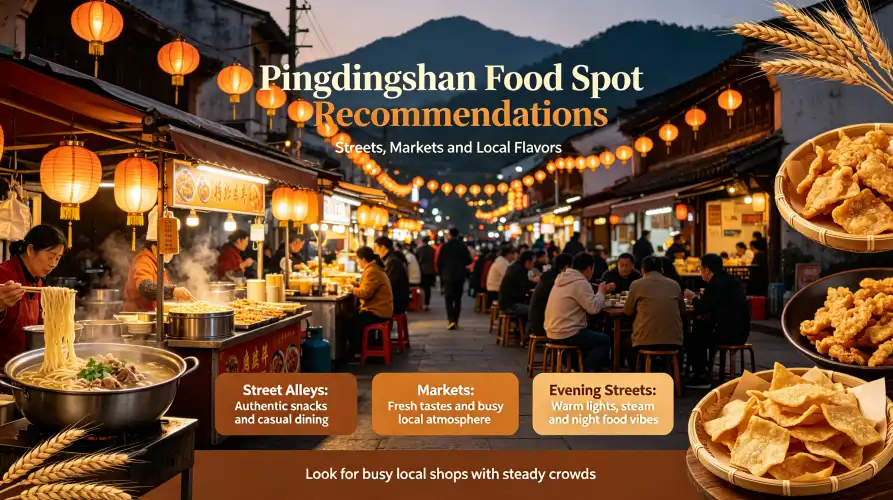
Recommended Food Gathering Places
Pingdingshan City
- Zhongxing Road Food Street – in Xinhua District, with many local restaurants serving Hele Noodles, mutton soup, Lan Guo Cai, and stir‑fried dishes.
- Kaiyuan Road Night Market – opens in the evening, mainly barbecue and snacks. Try grilled gluten, lamb skewers, and fried jelly.
- Wanda Plaza (Pingdingshan) – on the 4th floor, a variety of restaurants with standardized quality and ambiance – suitable for families.
Jiaxian County Town
Hele Noodle Street – along Wenhua Road and Dongpo Avenue, with many old Hele Noodle shops. Here you can taste the most authentic Jiaxian Hele Noodles.
Lushan County Town
Xiangyang Road Food Street – concentrated with Lan Guo Cai, wild vegetables, quancai, and other local specialties. There are also farmhouse restaurants at the entrance of Yao Mountain.
Baofeng County Town
Baofeng Mutton Soup shops – scattered across the county, with “Old Li” and “Old Zhao” being the most famous names.
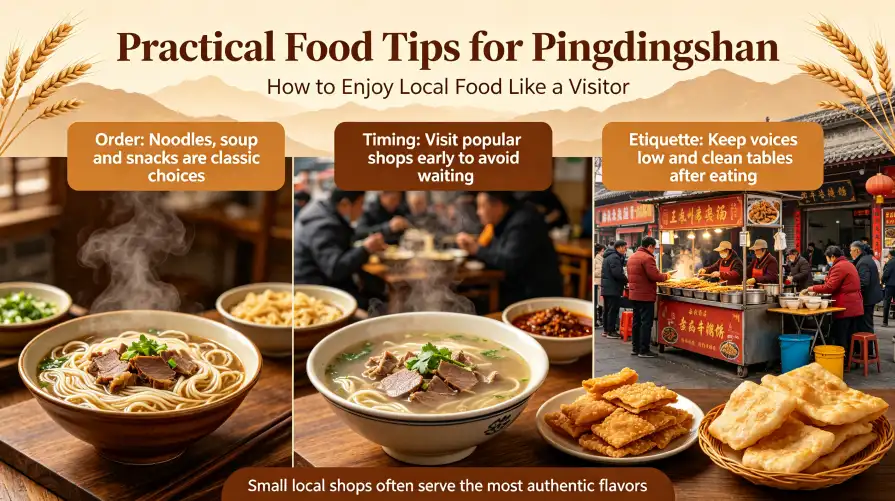
Practical Tips
Taste and Spiciness
Pingdingshan dishes are generally not spicy; they are savory and salty. Hele Noodle broth has no chili – chili oil is provided separately. Lan Guo Cai has a mild spice from the herbs but is not harsh. If you want spiciness, add chili oil or vinegar yourself.
Ordering Recommendations
- One person: A bowl of Jiaxian Hele Noodles (about 15 RMB) plus a cold quancai salad (about 15 RMB), or a bowl of mutton soup with a flatbread (about 20 RMB).
- Two persons: One small Lushan Lan Guo Cai (about 38–48 RMB) + one Hot Tofu (about 8 RMB) + two portions of rice or flatbread. Or two bowls of Hele Noodles + one cold dish.
- Souvenirs: Ru porcelain tea set (small pieces about 50–200 RMB); Jiaxian Hele Noodle seasoning packs (about 10–15 RMB per bag); Lushan dried quancai (about 20–30 RMB per bag).
Payment and Language
Restaurants and night markets accept WeChat Pay and Alipay. Link an international credit or debit card in advance. For night market stalls, carry 50–100 RMB in cash. Some small restaurants do not have English menus – use a translation app or point at what the next table is eating.
Vegetarian Friendliness
Pingdingshan has plenty of vegetarian options. Cold quancai, stir‑fried mountain mushrooms, scrambled eggs with edible fungus, hot tofu, and various stir‑fried greens are all vegetarian. When ordering, tell the server, “I am a vegetarian – no meat and no animal oil.”
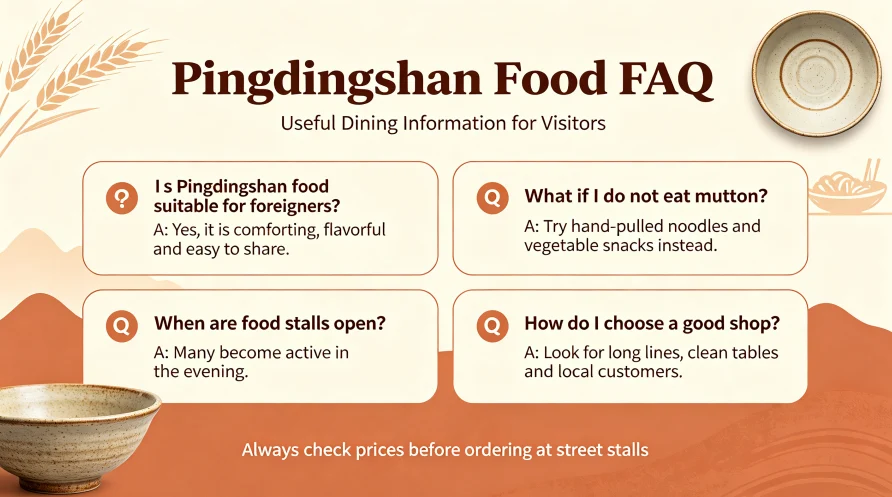
Frequently Asked Questions about Pingdingshan Food
Q: What is the difference between Jiaxian Hele Noodles and Lanzhou hand‑pulled noodles?
A: Hele Noodles are pressed from buckwheat or mixed flour using a hele press – the noodles are round and chewy; the broth is mutton‑based and not spicy. Lanzhou noodles are hand‑pulled with varying thicknesses, and the broth is beef‑based.
Q: Lan Guo Cai contains pork. Can I request it without meat?
A: Yes, but the traditional recipe includes pork belly, and removing it will change the flavor. Vegetarians may prefer other vegetable dishes.
Q: What souvenirs can I bring home from Pingdingshan?
A: Ru porcelain tea sets (small pieces), Jiaxian Hele Noodle seasoning packs, Lushan dried quancai, Baofeng liquor (one of China’s famous liquors – must be checked in), and Yexian braised noodle seasoning packs.
Q: What is the cost of dining in Pingdingshan?
A: Very affordable. A full meal costs about 20–40 RMB per person; a bowl of specialty noodles costs 12–20 RMB; night market snacks cost 5–15 RMB.
Pingdingshan food is the truest reflection of the rustic life of central Henan. From the century‑old tradition of Jiaxian Hele Noodles, to the mountain flavors of Lushan Lan Guo Cai, to the warmth of Baofeng Mutton Soup – every dish tells the story of this land. There are no fancy presentations or complicated techniques here, only the most honest ingredients and the most sincere flavors. Whether you need to refuel after visiting Yao Mountain or come specifically for the food, Pingdingshan welcomes you with its most genuine tastes.
May you enjoy both the magnificent scenery of the Funiu Mountains and the rich flavors of the Central Plains in Pingdingshan!
Related Reading:
- Pingdingshan Travel Guide 2026: Yaoshan Mountain, Giant Buddha & Itinerary
- Henan Travel Guide 2026: Itinerary, Attractions & Tips for Foreigners
- What is the Specialty of Henan Food? A Foreigner’s Guide to Henan Cuisine
- Zhengzhou Food Guide: Must-Try Dishes Like HuiMian & HuLaTang (2026)
- Zhengzhou famous food
- Jiaozuo Food Guide 2026: Must-Try Dishes, Huai Mansion Donkey Meat & Iron Yam
- 2026 Dengfeng Food Guide: Shaolin Veggie Delights & Local Snacks
- 2026 Luoyang Food Guide: Best Local Dishes, Water Banquet & Night Market Tips